This itinerary is an illustrative travel plan rather than a fixed package. Flight schedules, entry requirements, attraction hours, transportation options, and prices can change. Check official government, airline, transport, and attraction websites before booking.
14-Day Global Itinerary: An Ambitious Multi-Country Route
Seeing eight major cities in 14 days is possible, but it is a fast-paced travel style. This route is designed for travelers who want a broad introduction to Europe, the Middle East, Asia, and the United States while accepting that each destination receives only a limited amount of time.
The route connects Paris, Dubai, Bangkok, Singapore, Tokyo, Seoul, New York City, and Washington, D.C. It prioritizes major landmarks, straightforward transportation, and a logical sequence rather than trying to cover every attraction in each city.
The goal is not to suggest that every traveler should follow the route exactly. Instead, use it as a framework for understanding how a very ambitious multi-country trip can be organized, then adjust the number of cities according to your time, budget, energy, and travel priorities.
Planning a longer European section? Our Europe Backpacking Manual provides a separate framework for travelers who want to spend more time exploring Europe rather than moving across several continents in two weeks.
What Does This Route Offer?
A multi-country itinerary becomes easier to understand when each stop has a clear purpose. Paris provides European history and art, Dubai combines modern architecture with regional culture, Bangkok introduces Thailand’s temples and food scene, and Singapore offers a compact urban stop before continuing to Japan and South Korea.
The final section of the journey moves through New York City and Washington, D.C., allowing travelers to finish with major American landmarks and museums.
The trade-off is simple: the route gives you breadth rather than depth. You see many different places, but you have less time to explore neighborhoods, relax, revisit favorite places, or respond spontaneously to local experiences.
Key Facts at a Glance
| Detail | Planning Information |
|---|---|
| Total Duration | 14 days / 13 nights |
| Cities | Paris → Dubai → Bangkok → Singapore → Tokyo → Seoul → New York City → Washington, D.C. |
| Travel Style | Fast-paced, landmark-focused multi-country itinerary |
| Regions | Europe, Middle East, Southeast Asia, East Asia, and North America |
| Best Timing | Depends on the combined weather and entry requirements for every destination |
| Visa Requirements | Depend on nationality, passport, transit points, and destination-specific rules |
Before You Book: What Should You Check First?
- Check entry requirements: Verify visa, passport-validity, transit, and arrival requirements for every country on the route.
- Compare flight schedules: Look at total journey time, baggage rules, connection requirements, and airport changes rather than choosing flights by price alone.
- Allow realistic connection time: International connections can involve security, immigration, baggage collection, or terminal transfers.
- Consider travel insurance: Choose coverage appropriate for international medical care, cancellations, delays, baggage, and other risks relevant to your trip.
- Pack light: A compact carry-on can make frequent airport and hotel transfers easier, provided it meets each airline’s current baggage rules.
Days 1–3: Paris, France
Day 1: Arrival and Historic Paris
- Morning: Arrive in Paris and travel from Charles de Gaulle Airport to your accommodation using the current airport transport options.
- Afternoon: Explore Île de la Cité and the surrounding historic center, including Notre-Dame Cathedral and Sainte-Chapelle.
- Evening: Walk along the Seine and visit a viewpoint such as Trocadéro for Eiffel Tower views.
- Stay: Consider central neighborhoods with convenient metro access rather than choosing accommodation solely by proximity to one landmark.
Day 2: Eiffel Tower, Louvre, and the Right Bank
- Morning: Visit the Eiffel Tower. Check the official ticketing schedule before your trip because entry times and ticket availability can change.
- Late morning: Continue to the Louvre Museum and prioritize a small selection of galleries rather than attempting to see the entire collection.
- Afternoon: Walk toward the Champs-Élysées and Arc de Triomphe.
- Evening: Consider a Seine cruise or an evening neighborhood walk.
Day 3: Montmartre and Departure
- Morning: Explore Montmartre, including Sacré-Cœur and Place du Tertre.
- Lunch: Try traditional French dishes or pastries at a local café or bakery.
- Afternoon: Return to the airport with enough time for check-in, security, and any required immigration procedures.
- Evening: Fly onward to Dubai if the selected flight schedule fits the itinerary.
Paris Planning Tips
- Use public transportation for most city journeys and check the current fare products before arrival.
- Reserve popular attractions in advance when timed entry is required.
- Keep the first day flexible because flight delays and jet lag can affect arrival plans.
More Paris planning: Our Paris Vacation Analysis provides additional context on neighborhoods, accommodation, dining, and cultural planning for a longer Paris stay.
Days 4–5: Dubai, United Arab Emirates
Day 4: Modern Dubai and Desert Experiences
- Morning: Visit Downtown Dubai and choose an observation experience at Burj Khalifa if it fits your schedule.
- Afternoon: Explore Dubai Mall and the surrounding Downtown area.
- Late afternoon: Visit a traditional area such as the Gold Souk or Spice Souk.
- Evening: Join a desert excursion if you want to add a different landscape and cultural experience to the itinerary.
Day 5: Abu Dhabi or Dubai
- Option A: Take a day trip to Abu Dhabi and visit Sheikh Zayed Grand Mosque, following current visitor and dress requirements.
- Option B: Stay in Dubai and explore Palm Jumeirah, Jumeirah Beach, or another neighborhood.
- Evening: Fly onward to Bangkok when the flight schedule allows.
Dubai Planning Notes
Dress and behavior expectations can vary by setting. Religious sites have specific visitor requirements, and alcohol is regulated and generally limited to licensed venues. Check current local guidance before visiting.
Days 6–7: Bangkok, Thailand
Day 6: Temples and the Chao Phraya River
- Morning: Visit the Grand Palace and Wat Phra Kaew, checking current opening hours and visitor requirements before arrival.
- Midday: Continue to Wat Arun and explore the riverside area.
- Afternoon: Consider a boat trip through the Chao Phraya River and nearby canals.
- Evening: Explore Chinatown and try local Thai dishes from reputable food vendors.
Day 7: Markets and Departure
- Morning: Visit Chatuchak Weekend Market if your dates coincide with its operating days.
- Afternoon: Explore Wat Pho or another nearby attraction.
- Evening: Travel to the airport using the current rail, taxi, or transfer options and continue to Singapore.
Bangkok Planning Tips
- Use the city’s rail network when it provides a convenient alternative to road traffic.
- Carry a practical amount of local cash for smaller businesses while keeping cards available as a backup.
- Dress appropriately when visiting temples and follow posted photography and visitor rules.
Day 8: Singapore
A Compact Singapore Day
- Morning: Explore Gardens by the Bay and select the attractions that fit your available time.
- Midday: Walk around Marina Bay and visit an observation attraction if desired.
- Afternoon: Explore Chinatown, Little India, or another neighborhood that interests you.
- Evening: Continue sightseeing around Marina Bay or Sentosa depending on your energy level.
- Night: Take an onward flight to Tokyo if the schedule permits.
Singapore’s efficient public transportation makes a short visit practical, but one day is still only an introduction. Choose a few priority attractions rather than trying to cover the entire city.
Days 9–10: Tokyo, Japan
Day 9: Asakusa, Shibuya, and Shinjuku
- Morning: Start in Asakusa and visit Senso-ji and Nakamise-dori.
- Afternoon: Travel to Shibuya and explore the crossing, Hachiko area, and nearby streets.
- Evening: Continue to Shinjuku for restaurants, shopping, and nighttime city views.
- Stay: Shinjuku, Ginza, or another neighborhood with convenient rail connections.
Day 10: Meiji Shrine and Departure
- Morning: Visit Meiji Shrine and explore the surrounding Harajuku area.
- Afternoon: Explore Tsukiji Outer Market or another food-focused neighborhood.
- Evening: Travel to the airport and continue to Seoul.
Tokyo Transportation Tips
- Use a compatible IC transportation card or current digital equivalent where available.
- Allow extra time for large stations and transfers, especially when traveling with luggage.
- Follow platform signs and local etiquette when using trains.
More Tokyo detail: If Tokyo is one of your main stops rather than a two-day highlight, see our Tokyo Travel Manual for deeper guidance on transport, historic sites, and neighborhoods.
Day 11: Seoul, South Korea
Palaces, Traditional Neighborhoods, and City Views
- Morning: Visit Gyeongbokgung Palace and check current operating hours before arrival.
- Midday: Explore Bukchon Hanok Village while respecting local residential-area guidance.
- Afternoon: Choose N Seoul Tower, Myeongdong, or another central attraction.
- Evening: Explore Hongdae for restaurants, shops, and street performances.
- Night: Take the onward flight to New York if the schedule fits the itinerary.
The Seoul-to-New York segment is one of the longest flights in this itinerary. Plan for a major time-zone adjustment and avoid scheduling too many fixed activities immediately after arrival.
More Seoul planning: Our South Korea Travel Guide offers broader context if you decide to extend the Seoul stop into a longer South Korea trip.
Days 12–13: New York City, USA
Day 12: Statue of Liberty and Lower Manhattan
- Morning: Visit the Statue of Liberty and Ellis Island if tickets and ferry times fit your schedule.
- Afternoon: Explore the 9/11 Memorial area, Lower Manhattan, and Wall Street.
- Evening: Visit Times Square or attend a Broadway performance if pre-booked.
Day 13: Central Park and Midtown
- Morning: Walk through Central Park and visit the Metropolitan Museum of Art if desired.
- Afternoon: Choose between the Empire State Building, Top of the Rock, or another observation attraction.
- Late afternoon: Visit Grand Central Terminal before leaving Manhattan.
- Evening: Travel to Washington, D.C. by train if the selected schedule works for your plans.
New York Planning Tips
- Group attractions by neighborhood to reduce unnecessary travel across the city.
- Use public transportation for many journeys and check current fares and service information.
- Book popular attractions and performances ahead when timed entry or reservations are required.
Day 14: Washington, D.C.
National Mall and Major Landmarks
- Morning: Explore the National Mall, including the Lincoln Memorial and Washington Monument.
- Midday: Choose one or two Smithsonian museums based on your interests and available time.
- Afternoon: Consider the U.S. Capitol area or another major attraction.
- Evening: Have a final meal in Georgetown or another neighborhood before your return journey.
- Departure: Choose the airport and departure time based on your confirmed transportation and return flight.
How Should You Manage the Logistics of Eight Cities?
How Should You Approach the Flights?
- Compare total travel time, connection airports, baggage rules, and change policies.
- For complex international connections, leave enough time for security, immigration, terminal transfers, and possible delays.
- Consider whether separate tickets are worth the potential savings, especially when a missed connection would require purchasing a replacement ticket.
- Keep important booking confirmations accessible offline as well as online.
What Should You Pack for Eight Cities?
- Clothing: Choose versatile layers suitable for the expected conditions along the route.
- Shoes: Prioritize comfortable walking shoes because this itinerary involves substantial time on foot.
- Technology: Bring the appropriate travel adapter, charging cables, and a reliable power bank where permitted.
- Documents: Keep passport copies, booking information, insurance details, and other important records securely accessible.
- Toiletries: Follow current airline rules for liquids and carry-on items.
How Can You Manage Jet Lag?
- Adjust your sleep schedule gradually before major time-zone changes when practical.
- Use local daylight and regular meal times to help your body adapt to the new time zone.
- Keep the first activities after a long-haul flight flexible.
- Stay hydrated and avoid relying on excessive caffeine or alcohol to manage fatigue.
How Should You Build a Budget for a 14-Day Global Trip?
The following figures are planning examples rather than fixed 2026 prices. Actual costs can vary substantially according to departure city, travel dates, airline, hotel category, exchange rates, baggage choices, attraction tickets, and booking timing.
| Category | Planning Range | What Can Affect the Cost |
|---|---|---|
| International Flights | Highly variable | Origin, season, cabin, baggage, connections, and booking timing |
| Accommodation | Highly variable | City, neighborhood, room type, dates, and hotel category |
| Local Transport | Variable | Airport transfers, public transport, taxis, and intercity trains |
| Attractions & Tours | Variable | Landmark tickets, museums, guided tours, and special experiences |
| Food & Drinks | Variable | Restaurant choices, location, and meal frequency |
| Total Trip Cost | Depends on travel style | Luxury, mid-range, and budget travelers can have very different totals |
For a more useful personal budget, calculate each city separately and then add the major intercity and international transportation costs. This makes it easier to adjust the route if one destination or travel segment becomes too expensive.
For the Southeast Asia portion: Our Budget Travel in Southeast Asia guide provides a more focused look at keeping costs under control in Thailand, Vietnam, and Cambodia.
What Mistakes Can Make This Itinerary Harder?
| Common Mistake | Better Approach |
|---|---|
| Trying to visit every major attraction | Choose a small number of priorities in each city. |
| Booking every transfer with the shortest possible connection | Allow realistic time for security, immigration, terminals, and delays. |
| Assuming visa rules are the same for everyone | Check requirements based on your nationality and itinerary. |
| Using fixed online prices as a guaranteed budget | Compare current prices shortly before booking. |
| Overpacking for multiple climates | Use layers and versatile clothing and check laundry options. |
| Scheduling major attractions immediately after long-haul flights | Leave room for delays and jet lag. |
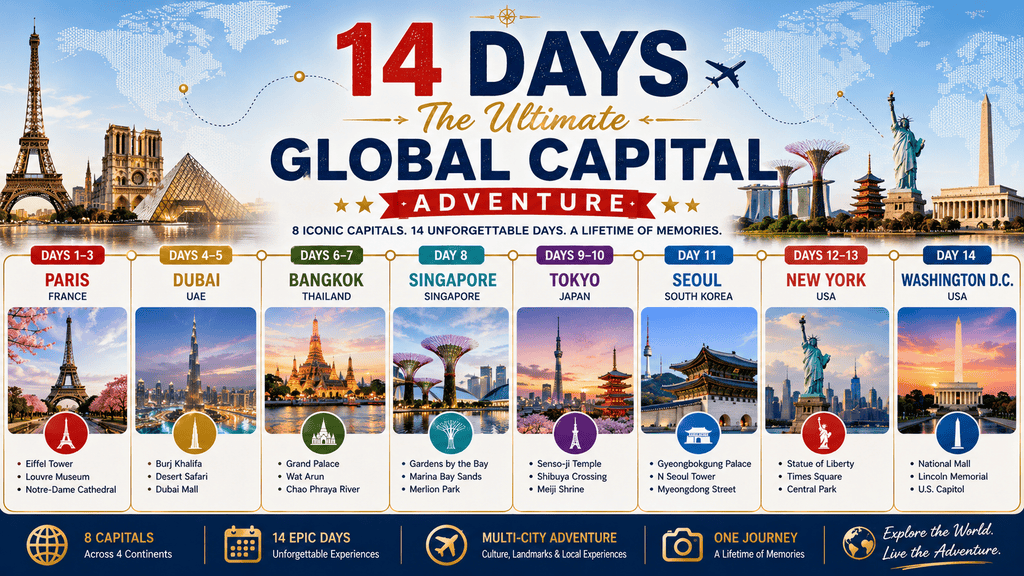
14-Day Global Itinerary Timeline
| Day | City | Key Experiences |
|---|---|---|
| 1–3 | Paris | Eiffel Tower, Louvre, Notre-Dame, Montmartre |
| 4–5 | Dubai | Burj Khalifa, Dubai Mall, traditional souks, optional desert excursion |
| 6–7 | Bangkok | Grand Palace, Wat Arun, Chinatown, markets |
| 8 | Singapore | Gardens by the Bay, Marina Bay, Chinatown or Little India |
| 9–10 | Tokyo | Senso-ji, Shibuya, Shinjuku, Meiji Shrine |
| 11 | Seoul | Gyeongbokgung, Bukchon, Myeongdong or N Seoul Tower |
| 12–13 | New York City | Statue of Liberty, Lower Manhattan, Central Park, Midtown |
| 14 | Washington, D.C. | National Mall, Smithsonian museums, Capitol area |
Is a 14-Day Global Trip Right for You?
This itinerary suits travelers who enjoy frequent movement and want a broad introduction to several regions. It is less suitable for travelers who prefer slow travel, long stays, relaxed mornings, or deep exploration of individual destinations.
Choosing this style of trip means accepting more airport transfers, more packing and unpacking, more time spent in transit, and less flexibility in each destination. The benefit is variety: you can experience several very different cities within a single two-week journey.
If the schedule feels too aggressive, the easiest adjustment is to remove one or two cities. Adding extra nights to fewer destinations can reduce airport transfers and provide more time for neighborhoods, food, museums, and spontaneous activities.
- Choose the full route if variety and seeing many destinations are more important to you than a relaxed pace.
- Shorten the route if you want more time to experience individual cities.
- Build your own version by keeping the cities that match your interests and removing destinations that add too much transit for the time available. If you want a deeper European history focus, you could also consider replacing one stop with Rome; our Rome and Vatican Guide provides a separate planning starting point.
Final Thoughts
A 14-day journey through eight major cities is an ambitious way to experience a wide range of cultures, landscapes, transportation systems, food traditions, and historic landmarks. The key is to treat this itinerary as a framework rather than a rigid schedule.
Before departure, confirm every major flight, accommodation, attraction reservation, and entry requirement. During the trip, leave enough flexibility to deal with delays, fatigue, weather, and changes in local conditions.
For travelers who enjoy a fast pace, this route can provide a memorable introduction to eight very different cities in a relatively short period. For a more relaxed experience, use the same route as a starting point and extend the stays that interest you most.
Related safety planning: Our Secure Travel Safety Handbook covers practical precautions for protecting personal data, money, and important travel documents while traveling internationally.
Planning note: Travel requirements, transportation schedules, attraction access, and prices can change. Always confirm current information with official sources before booking or departing.