
Route 66 is a historic road rather than one continuous modern highway. Road conditions, attraction hours, accommodation availability, fuel prices, and admission fees can change, so verify current information with official sources before traveling.
Route 66 Road Trip at a Glance
Planning a Route 66 road trip is less about following one uninterrupted highway and more about connecting surviving historic road sections, preserved landmarks, museums, diners, small towns, and roadside attractions across the United States.
Historic U.S. Route 66 was established in 1926 and originally connected Chicago with the Los Angeles area through Illinois, Missouri, Kansas, Oklahoma, Texas, New Mexico, Arizona, and California. The route was officially decommissioned in 1985, but many historic sections and related attractions remain accessible to travelers.
This guide explains how to plan a practical Route 66 journey, including route planning, timing, vehicle preparation, accommodation, food, budgeting, major stops, safety considerations, and common mistakes to avoid.
| Detail | Practical Information |
|---|---|
| Historic route | Chicago to the Santa Monica/Los Angeles area |
| Approximate historic length | About 2,400 miles |
| States | Illinois, Missouri, Kansas, Oklahoma, Texas, New Mexico, Arizona, California |
| Historic period | 1926–1985 |
| Suggested trip | Approximately 14–21 days for a relaxed itinerary |
| Faster trip | Approximately 10–14 days with fewer stops |
| Travel style | Self-drive road trip |
Because the original highway was decommissioned, travelers should expect to use modern roads together with surviving Historic Route 66 sections. The exact route may vary depending on road conditions, local access, and the historic alignment being followed.
Why Travel Route 66?
Route 66 is especially appealing to travelers interested in American road history, classic automobiles, roadside architecture, small towns, museums, diners, and changing landscapes.
Historic Road Culture
The highway developed alongside America’s growing automobile culture. Gas stations, motels, restaurants, repair shops, and tourist attractions became important parts of communities along the route.
Changing Landscapes
- Urban Chicago
- Illinois farmland
- Missouri’s rolling landscapes
- Oklahoma and Texas plains
- New Mexico’s high desert
- Arizona’s desert scenery
- California’s Mojave Desert and coastal region
Small-Town Experiences
Some of the most interesting stops are smaller communities rather than major cities. Historic downtowns, museums, diners, preserved service stations, and roadside buildings help illustrate how travel developed along the highway.
Understanding the Historic Route
One of the most important things to understand before planning a Route 66 trip is that the historic highway no longer exists as one uninterrupted modern road.
The original highway was decommissioned in 1985 as the interstate highway system increasingly replaced its transportation role. Today, Route 66 travelers combine surviving historic road segments with modern highways and local roads.
A useful itinerary therefore distinguishes between:
- Historic Route 66 sections that remain accessible
- Modern highways used to connect historic sections
- Side trips that require leaving the historic route
- Museums and attractions associated with Route 66 heritage
This approach provides more flexibility and prevents confusion when a historic alignment differs from the modern road network.
When to Take a Route 66 Road Trip
There is no single ideal month for the entire route because Route 66 crosses several climate zones. Conditions in Chicago can be very different from those in Arizona or Southern California during the same week.
| Season | Months | Advantages | Considerations |
|---|---|---|---|
| Spring | March–May | Generally comfortable temperatures in many areas and increasing daylight | Weather can change quickly; northern sections may remain cool early in the season |
| Summer | June–August | Long daylight hours and convenient for many holiday schedules | Very hot conditions are possible in desert areas; popular attractions can be busy |
| Fall | September–October | Often comfortable temperatures and good conditions for sightseeing | Daylight becomes shorter later in the season; some seasonal businesses may reduce hours |
| Winter | November–February | Potentially quieter conditions | Snow and freezing weather are possible in northern sections; some seasonal attractions may close |
Practical recommendation: Spring and early fall can be useful planning periods for a cross-country Route 66 journey, but check weather forecasts for each region rather than relying on a single forecast for the whole route.
How Many Days Do You Need?
Your ideal trip length depends on whether you want to cover distance quickly or spend more time exploring individual communities.
| Duration | Travel Style |
|---|---|
| 7–10 days | Fast-paced trip focused on major highlights |
| 10–14 days | Focused road trip with selected stops |
| 14–21 days | More balanced pace with time for towns and attractions |
| 21+ days | Slow travel with additional side trips and longer stays |
For many first-time travelers, 14–21 days provides a useful framework because it leaves room for museums, historic districts, meals, photography, and unexpected stops.
Sample 14-Day Route 66 Itinerary
The following itinerary is a planning framework rather than a fixed schedule. Driving times can change because of traffic, road conditions, weather, and the number of historic sections you choose to follow.
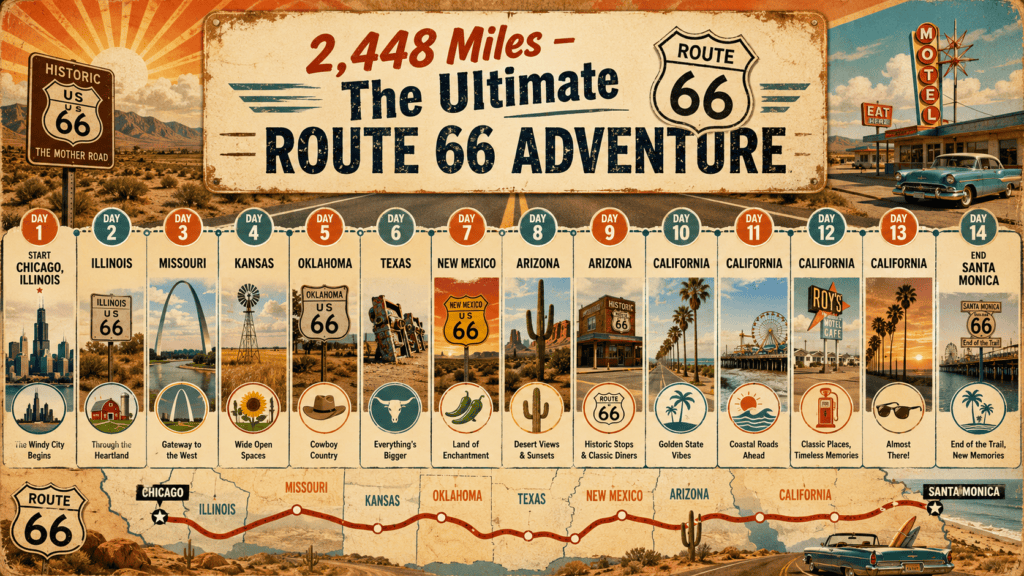
| Day | Suggested Area | Focus |
|---|---|---|
| 1 | Chicago | Route 66 heritage and city sightseeing |
| 2 | Chicago → Springfield, Illinois | Historic Illinois Route 66 communities |
| 3 | Springfield → St. Louis | Historic sites and Gateway Arch area |
| 4 | St. Louis → Springfield, Missouri | Missouri Route 66 communities |
| 5 | Missouri → Tulsa | Historic Oklahoma attractions |
| 6 | Tulsa → Oklahoma City | Route 66 museums and city attractions |
| 7 | Oklahoma City → Amarillo | Oklahoma and Texas Route 66 |
| 8 | Amarillo → Santa Rosa | Cadillac Ranch and New Mexico transition |
| 9 | Santa Rosa → Albuquerque | Historic New Mexico communities |
| 10 | Albuquerque → Holbrook | New Mexico and eastern Arizona |
| 11 | Holbrook → Flagstaff/Williams | Petrified Forest area and northern Arizona |
| 12 | Williams → Kingman | Historic Arizona Route 66 |
| 13 | Kingman → Barstow | Mojave Desert and California Route 66 |
| 14 | Barstow → Santa Monica | Final California section and Pacific coast |
If you have additional time, consider adding nights in Chicago, St. Louis, Tulsa, Albuquerque, Flagstaff, or Santa Monica instead of simply adding more driving distance.
Pre-Trip Planning: Vehicle, Documents, Budget, and Packing
Vehicle Preparation
Whether you rent a car, RV, or motorcycle, inspect the vehicle before beginning a long-distance journey.
- Check tires and tire pressure.
- Check brakes and essential fluids.
- Confirm the battery and cooling system are in good condition.
- Test the air conditioning, particularly if traveling through desert areas.
- Confirm the spare tire or emergency tire equipment.
- Know how to contact roadside assistance.
Navigation
- Download offline maps before entering rural areas.
- Save important accommodation and attraction locations.
- Keep a backup map or route notes available.
- Check road closures before using remote historic sections.
- Plan fuel stops in advance.
Documents and Driving Requirements
International travelers should check the current entry requirements for the United States before departure. Driving requirements can also vary by state and rental company.
- Valid passport and required travel authorization
- Valid driver’s license
- Rental-car documentation, if applicable
- Insurance information
- Payment cards and emergency contact information
- International Driving Permit if required by the relevant state or rental company
Do not assume that an International Driving Permit is automatically required for every international visitor. Check the rules for each state on your planned route and confirm the rental company’s requirements before traveling.
Emergency Supplies
- Drinking water
- Basic first-aid supplies
- Flashlight
- Portable phone charger
- Sun protection
- Basic roadside emergency equipment
Route 66 Budget Planning
Route 66 costs vary considerably depending on vehicle type, travel season, accommodation style, number of travelers, fuel consumption, and the number of attractions included. For a full Chicago-to-Santa Monica trip, it is useful to separate the costs that are shared by the vehicle from costs that rise with each traveler.
Illustrative 14-day planning example: Recent 2026 Route 66 budget guides place a two-person trip in a broad range of roughly $3,000–$5,000 before international flights, depending on rental-car pricing, one-way drop fees, accommodation choices, food, fuel, and attractions. Treat this as a planning reference rather than a quoted trip price; actual costs can move substantially with dates, vehicle choice, and booking conditions.
| Category | Illustrative 14-Day Example for 2 Travelers | What to Include |
|---|---|---|
| Rental vehicle | $700–$1,600 | Daily rental, taxes, one-way fees, and optional equipment |
| Fuel | $300–$550 | Total driving distance, detours, and the vehicle’s fuel efficiency |
| Accommodation | $1,000–$2,400 | Hotels, historic motels, campgrounds, or other lodging |
| Food | $700–$1,000 | Meals, drinks, snacks, and occasional special dining for two |
| Attractions & parking | $150–$500 | Museums, parks, tours, activities, and parking where applicable |
| Insurance | Varies | Rental coverage and travel insurance, depending on existing coverage |
| Contingency | Set aside separately | Unexpected repairs, delays, changes, or additional nights |
The figures above are an illustrative planning example, not a promise that a complete trip will fall within one fixed total. For example, current published estimates vary because some guides include the rental car and one-way drop fee while others exclude vehicle costs or use different lodging assumptions. Flights to Chicago and the return journey from California are not included.
Rather than relying on one fixed daily price, build your own budget around the major cost categories below and replace the example figures with current quotes for your travel dates.
| Category | What to Include |
|---|---|
| Rental vehicle | Daily rental, taxes, one-way fees, and optional equipment |
| Fuel | Total driving distance and the vehicle’s fuel efficiency |
| Accommodation | Hotels, historic motels, campgrounds, or other lodging |
| Food | Meals, drinks, snacks, and occasional special dining |
| Attractions | Museums, parks, tours, and activities |
| Parking | City, attraction, and hotel parking where applicable |
| Insurance | Rental coverage and travel insurance |
| Contingency | Unexpected repairs, delays, changes, or additional nights |
Simple planning formula: vehicle + fuel + accommodation + food + attractions + parking + insurance + contingency.
Because prices change frequently, verify current rental rates, accommodation prices, fuel costs, park fees, and attraction admission prices shortly before booking.
Step-by-Step Route Guide
Illinois: Chicago to the Missouri Border
Illinois provides the eastern starting point and contains numerous communities associated with Route 66 history.
Possible stops: Chicago, Joliet, Pontiac, Lincoln, and Springfield.
- Chicago: Explore Route 66 heritage locations alongside the city’s major attractions.
- Joliet: Consider Route 66 museums and historic attractions.
- Pontiac: Explore Route 66 murals, museums, and preserved roadside features.
- Springfield: Combine Route 66 history with attractions associated with Abraham Lincoln.
Allow additional time in Springfield if you want to visit museums and historic sites rather than simply passing through.
Missouri: St. Louis and the Ozarks
Missouri contains a substantial portion of the historic route and offers several towns where Route 66 heritage remains visible.
- St. Louis: Consider Gateway Arch National Park and Route 66-related attractions.
- Cuba: Known for Route 66 murals and roadside heritage.
- Lebanon: A useful stop for travelers exploring the Missouri section.
- Springfield: Offers Route 66 museums and other attractions.
Kansas: A Short Historic Section
Kansas contains one of the shortest sections of historic Route 66, passing through communities including Galena and Baxter Springs.
Because the mileage is relatively short, this section can be combined with a longer driving day while still leaving time for photographs and local attractions.
Oklahoma: Route 66 Heritage
Oklahoma contains numerous Route 66 attractions and communities, making it a useful state for travelers interested in road history.
- Tulsa: Explore Route 66-related districts and historic attractions.
- Oklahoma City: Combine Route 66 sightseeing with museums and city attractions.
- Clinton: Consider the Oklahoma Route 66 Museum.
Check museum opening hours before visiting because schedules can change.
Texas: The Panhandle Section
- Shamrock: Visit the U-Drop Inn, an important surviving Route 66 building.
- Amarillo: Consider Cadillac Ranch and the historic Route 66 district.
- Adrian: Visit the historic midpoint area associated with the Chicago–Los Angeles route.
Adrian’s midpoint designation refers to the historic Chicago–Los Angeles alignment and should not be interpreted as the exact midpoint of every modern routing option.
New Mexico: Historic Towns and Desert Landscapes
- Tucumcari: Explore historic motels, murals, and Route 66 roadside heritage.
- Santa Rosa: A possible stop between eastern and central New Mexico.
- Albuquerque: Provides more accommodation and dining options than many smaller Route 66 communities.
If you want to explore Albuquerque properly, consider staying an additional night rather than treating the city only as a driving stop.
Arizona: Route 66 and Desert Scenery
- Holbrook: Known for classic Route 66 attractions including the Wigwam Motel.
- Winslow: A popular stop for Route 66 heritage and Americana.
- Flagstaff: Useful as an overnight base in northern Arizona.
- Williams: Associated with both Route 66 and access to the Grand Canyon Railway.
- Seligman: Strongly associated with Historic Route 66 preservation.
- Kingman: A useful base before continuing toward California.
Grand Canyon National Park can be added as a side trip, but allow sufficient time because it is not simply a roadside stop on the historic Route 66 alignment.
California: The Final Section
The California portion crosses desert landscapes before reaching the greater Los Angeles area and the Pacific coast.
- Needles: A useful eastern California stop.
- Barstow: Consider Route 66 museums and roadside attractions.
- Victorville: Explore local Route 66 heritage.
- San Bernardino: Another important Southern California stop.
- Santa Monica: Finish the journey near the Pacific coast.
Spend some time in Santa Monica at the end of the journey rather than treating the final destination as only a photo stop.
Where to Stay Along Route 66
Accommodation ranges from historic motels to modern hotel chains and campgrounds.
Historic Motels
- Wigwam Motel in Holbrook, Arizona
- Blue Swallow Motel in Tucumcari, New Mexico
- El Vado Motel in Albuquerque, New Mexico
- Other preserved Route 66 properties along the route
Operating status, room availability, and rates can change, so confirm directly with the property before building your itinerary around a specific motel.
Modern Hotels
Larger cities and towns generally provide a wider range of accommodation. Common overnight bases include Chicago, Springfield, St. Louis, Tulsa, Oklahoma City, Amarillo, Albuquerque, Flagstaff, Barstow, and Santa Monica.
Camping
Camping can provide additional flexibility, but campground availability, reservation requirements, and regulations vary. Check the relevant campground or public-land authority before traveling.
Food Along Route 66
Food is an important part of the road-trip experience. Instead of planning every meal around famous restaurants, leave room for locally operated diners, cafés, bakeries, and restaurants in smaller communities.
- Chicago-style pizza
- Classic American diners
- Oklahoma onion burgers
- New Mexican green chile dishes
- Texas barbecue and steak
- Classic roadside desserts and drinks
Opening hours can vary, particularly in smaller towns, so check current information before making a long detour for a specific restaurant.
Interesting Side Trips
Travelers with additional time can add selected attractions away from the core Route 66 alignment.
- Gateway Arch National Park
- Petrified Forest National Park
- Grand Canyon National Park
- Meteor Crater
- Palo Duro Canyon
- Route 66 museums and local historic districts
Side trips can add substantial driving time. Treat them as separate itinerary decisions rather than assuming they are directly on Route 66.
Common Route 66 Planning Mistakes
Trying to Drive Too Far Every Day
A road trip becomes less enjoyable when every day is dominated by driving. Leave time for museums, meals, photographs, local attractions, weather changes, and rest.
Treating Route 66 as One Continuous Road
The original highway was decommissioned in 1985 and now survives through multiple historic sections and alignments. Plan around the specific segments you want to experience.
Ignoring Fuel Planning
Some rural areas offer fewer services than major cities. Check the next available fuel opportunity before entering a long remote section.
Relying Only on Online Navigation
Download important maps and route information before leaving areas with reliable connectivity.
Planning Every Hour
Historic road trips often benefit from flexibility. Leave some space for unexpected attractions, local events, meals, or weather-related changes.
Ignoring Desert Weather
Desert conditions can become extremely hot during summer. Carry sufficient water, use sun protection, and check weather conditions before long driving days.
Related safety planning: Before a long international road trip, our Secure Travel Safety Handbook covers practical ways to protect your personal data, wallet, and important travel documents while traveling internationally.
Practical Route 66 Safety Tips
- Check weather forecasts before long driving days.
- Avoid driving when fatigued.
- Take regular breaks during long journeys.
- Keep drinking water available.
- Follow posted speed limits and local traffic rules.
- Check road conditions before using remote historic sections.
- Do not enter closed roads or private property.
- Keep your vehicle adequately fueled in rural areas.
- Follow current safety guidance at national parks and protected areas.
How to Build Your Own Route 66 Itinerary
Step 1: Choose Your Trip Length
Start by deciding whether you have 10, 14, 21, or more days available.
Step 2: Choose Your Priorities
- Road history
- Photography
- Food
- Small towns
- National parks
- Museums
- Classic cars
- Architecture
Step 3: Select Overnight Bases
Choose overnight locations based on realistic driving distances and the attractions you want to visit.
Step 4: Add Side Trips
Add major detours only after the core route is established. This makes it easier to understand how much extra driving each side trip requires.
Step 5: Check Current Conditions
- Road conditions
- Attraction opening hours
- Accommodation availability
- Weather
- National park alerts
- Rental-car requirements
Step 6: Keep the Schedule Flexible
Leave some room for unexpected discoveries, delays, weather changes, and additional stops.
Final Route 66 Planning Checklist
- Valid travel documents
- Appropriate driving credentials
- Rental-car confirmation, if applicable
- Insurance information
- Accommodation reservations
- Offline navigation
- Emergency contacts
- Weather information
- Fuel plan
- Attraction opening hours
- Backup payment method
- Water and basic emergency supplies
Conclusion
Route 66 offers a way to explore American transportation history, roadside culture, small communities, and changing landscapes across eight states.
Although the original highway was decommissioned in 1985, surviving road segments, museums, historic buildings, roadside attractions, and preservation projects continue to provide opportunities for modern travelers to experience its legacy.
The most useful itinerary is not necessarily the one with the most stops. Give yourself enough time to explore the places that interest you, remain flexible when conditions change, and verify current information before traveling.
With realistic driving days, a sensible vehicle plan, flexible accommodation choices, and enough time for local stops, a Route 66 journey can become a rewarding cross-country road trip from Chicago toward Santa Monica.