All prices mentioned in this guide are indicative planning ranges rather than fixed prices. Accommodation costs, coworking fees, transportation, food, and other expenses can fluctuate based on season, exchange rates, availability, location, and booking timing. Visa requirements and service availability can also change. Check current information directly with official Japanese government sources, transport operators, accommodation providers, coworking spaces, and other relevant websites before finalizing your plans.
Introduction
Tokyo is an attractive destination for digital nomads and remote workers who want to combine modern infrastructure, reliable connectivity, efficient public transportation, and a distinctive cultural environment. For travelers who are visiting Tokyo for the first time, our Tokyo First-Time Visitor guide provides a broader introduction to navigating the city before planning a longer remote-work stay. The city is large and relatively expensive compared with many destinations in Southeast Asia, but careful choices about accommodation, food, transportation, and workspace can make a longer stay more manageable.
This guide presents Tokyo from a practical planning perspective, focusing on affordable accommodation options, suitable neighborhoods, coworking spaces and cafes, transportation, connectivity, visa considerations, and a sample one-month routine for remote workers. It is intended as a planning resource rather than a report of personal travel experience.
Why Tokyo for Digital Nomads?
Tokyo offers several characteristics that can appeal to remote workers:
- Reliable connectivity: Tokyo has extensive broadband and mobile connectivity options, although performance can vary by accommodation, workspace, and provider.
- Public safety: Tokyo is generally regarded as a safe major city, but normal precautions remain appropriate for travelers and remote workers.
- Rich culture: Traditional temples, shrines, neighborhoods, museums, food culture, and modern entertainment provide many options outside working hours.
- Efficient public transportation: The city’s extensive rail and subway systems make it possible to reach many neighborhoods without relying on a car.
- Diverse food options: Convenience stores, supermarkets, casual restaurants, food halls, and local eateries provide a wide range of meal choices for different budgets.
Budget Accommodation Options
Accommodation is likely to be one of the largest expenses for a digital nomad staying in Tokyo. The following figures are broad planning ranges rather than guaranteed market prices.
| Accommodation Type | Indicative Monthly Cost (USD) | Best For |
|---|---|---|
| Shared Hostel Dorm | $400–700 | Solo travelers and tight budgets |
| Private Hostel Room | $700–1,200 | Travelers seeking more privacy |
| Budget Hotel | $900–1,500 | Shorter stays and convenience |
| Short-Term Apartment | $1,200–2,500 | Longer stays, couples, or groups |
Actual prices can be substantially different depending on neighborhood, room size, season, booking platform, minimum-stay requirements, and whether utilities or other fees are included. Always compare the final payable amount rather than relying only on the advertised nightly or monthly rate.
Recommended Neighborhoods for Budget Living
Choosing the right neighborhood can make a significant difference to both accommodation costs and commuting time. These areas are worth considering when comparing options:
- Asakusa: Known for its traditional atmosphere, historic attractions, and a range of accommodation options.
- Ueno: Convenient transportation, parks, museums, shopping, and a wide range of food choices.
- Ikebukuro: A busy commercial district with extensive rail connections and accommodation across several price levels.
- Shinjuku: Extremely convenient for transportation and business activities, although accommodation can be more expensive in some locations.
Coworking Spaces and Cafes
Coworking Spaces to Research
Tokyo has a large coworking market, ranging from international operators to Japanese shared-workspace communities. Availability, pricing, access rules, and locations can change, so check each provider’s current information before purchasing a membership.
- WeWork: An international coworking provider with locations in Tokyo and options that may suit professionals looking for a structured working environment.
- Co-ba: A Japanese coworking community with locations and programs aimed at entrepreneurs, freelancers, and other independent professionals.
- Local coworking spaces: Independent spaces throughout Tokyo can provide alternatives to large international operators, particularly for travelers who prefer smaller communities.
- Flexible workspace services: Day passes and short-term workspace options can be useful when a monthly membership is unnecessary.
Working from Cafes
Cafes can be useful for occasional remote work, but not every location permits long laptop sessions or guarantees strong Wi-Fi. Before settling in for several hours, check the cafe’s current rules, seating availability, power outlets, and internet conditions.
- Starbucks locations: Some branches provide Wi-Fi and convenient seating, but policies and availability vary by location.
- Blue Bottle Coffee: Selected Tokyo locations can be considered for a coffee break or shorter work session, subject to seating and store policies.
- Independent cafes: Smaller cafes can offer a quieter atmosphere, but laptop use, Wi-Fi, and power access should be checked before planning a long work session.
Cost of Living Breakdown
A realistic Tokyo budget depends heavily on accommodation and lifestyle. The following ranges are useful as broad planning categories rather than fixed monthly prices.
| Category | Indicative Monthly Budget (USD) | Details |
|---|---|---|
| Accommodation | $400–1,500+ | Varies by privacy, location, season, and accommodation type |
| Food | $400–800 | Depends on groceries, casual meals, restaurants, and lifestyle |
| Transport | $100–200 | Depends on commuting frequency, rail routes, and taxi use |
| Coworking | $200–400 | Varies by provider, location, membership, and access level |
| Entertainment | $200–400 | Attractions, events, leisure activities, and nightlife |
| Total Planning Range | $1,300–3,300+ | Can vary considerably according to lifestyle and accommodation |
Travelers who prioritize private accommodation, premium coworking spaces, frequent restaurant meals, taxis, and entertainment may spend considerably more. Those using shared accommodation, public transport, supermarkets, and free attractions may be able to operate on a lower budget.
Public Transportation Tips
- IC transportation cards: Compatible IC cards such as Suica or PASMO can make many train and subway journeys easier. Check current availability and supported payment methods before arrival.
- Tourist and time-limited passes: Tokyo has several transport products, but their value depends on the routes and frequency of travel. Compare the current conditions before purchasing.
- JR services: Travelers planning trips outside Tokyo should compare individual fares with current rail passes rather than assuming a nationwide pass will always provide savings.
Visa Options for Digital Nomads
Japan introduced a Digital Nomad visa framework in 2024 for eligible foreign nationals working remotely under specified conditions. Visa eligibility, income requirements, permitted activities, accompanying-family rules, insurance requirements, and application procedures should be checked against the latest information published by Japanese immigration authorities or the relevant Japanese embassy or consulate.
- Eligibility: Requirements depend on nationality, employment or business situation, income, insurance, and other conditions established by Japanese authorities.
- Duration: The Digital Nomad status is designed for a limited stay rather than permanent residence. Confirm the currently permitted period before making long-term plans.
- Application: Prepare the documents requested by the relevant Japanese authorities and verify the current application procedure before submitting anything.
Visa rules can change, so older blog posts and social-media summaries should not be treated as the final authority for immigration decisions.
Network and Connectivity Tips
- Mobile data: Travelers can compare local SIM and eSIM providers according to coverage, data allowance, contract length, and activation requirements.
- Public Wi-Fi: Wi-Fi may be available in stations, cafes, hotels, and other public locations, but reliability and security can vary. Avoid assuming that every public network is suitable for sensitive work.
- VPN and security: Remote workers handling business accounts or sensitive information should use appropriate account-security practices and secure connections. For broader guidance on protecting personal information and money while traveling internationally, see our Secure Travel Safety Handbook.
- Backup connectivity: A local data plan or eSIM can provide a useful backup when accommodation or cafe Wi-Fi is unavailable.
Suggested 1-Month Digital Nomad Timeline
The following four-week schedule is an illustrative framework for travelers who want to combine remote work with gradual exploration of Tokyo. It can be adjusted according to workload, accommodation location, budget, and personal interests.
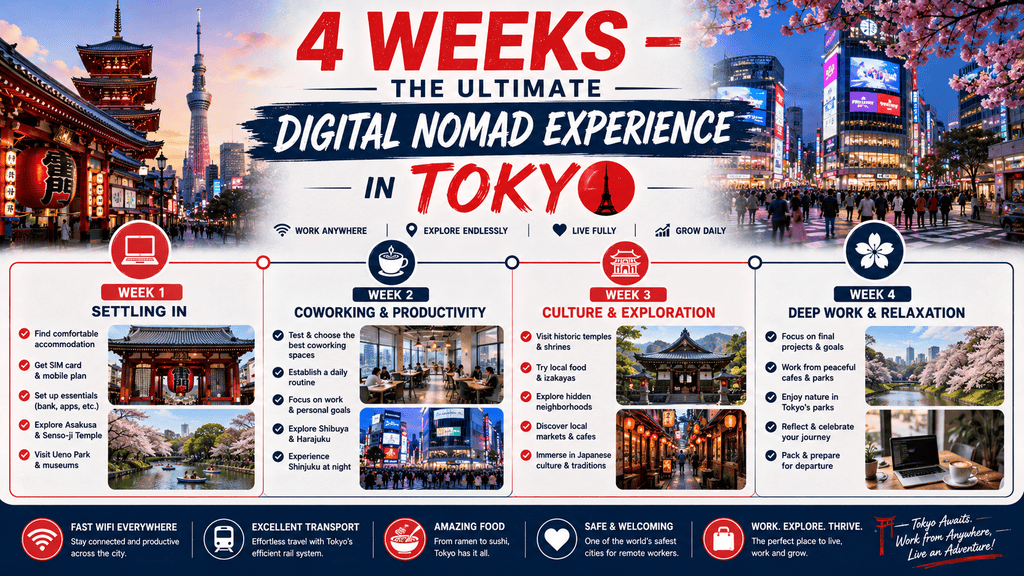
| Week | Focus | Highlights |
|---|---|---|
| Week 1 | Settling In | Confirm accommodation, arrange connectivity, learn local transport, explore Asakusa and Ueno |
| Week 2 | Coworking & Productivity | Compare workspace options, establish a work routine, explore Shibuya and Shinjuku |
| Week 3 | Culture & Exploration | Visit temples, museums, food districts, and neighborhoods outside the main tourist routes |
| Week 4 | Deep Work & Relaxation | Focus on projects, visit parks and quieter areas, organize belongings, and prepare for departure |
Conclusion
Tokyo can be a strong option for digital nomads who value modern infrastructure, extensive public transportation, cultural variety, and reliable connectivity. A broad planning range of around $1,300–3,300 or more per month can be used as a starting point, but actual spending depends heavily on accommodation, lifestyle, season, exchange rates, and workspace choices. For travelers planning a longer multi-destination trip, our 14-Day Global Itinerary can provide another planning reference for combining major cities and destinations.
Neighborhoods such as Asakusa, Ueno, Ikebukuro, and Shinjuku offer different combinations of transportation access, accommodation choices, food options, and proximity to attractions. The best choice depends on whether the priority is lower accommodation costs, central access, nightlife, cultural surroundings, or a convenient commute.
For remote workers considering a longer stay, the most important preparation steps are to verify current visa requirements, compare accommodation carefully, arrange reliable connectivity, understand local transportation, and choose a workspace that matches the demands of the job.
Tokyo is best approached with a flexible plan. By balancing work commitments with realistic sightseeing time and by checking current prices and official requirements before departure, digital nomads can build a practical stay without relying on outdated assumptions or a one-size-fits-all budget.