Travel information such as fares, opening hours, admission fees, transport policies, and event schedules can change. Treat prices and schedules in this guide as general planning references and verify important details with official operators or attraction websites before traveling.
Tokyo for First-Time Visitors: What Should You Plan First?
Tokyo can feel overwhelming on a first visit because its railway network, neighborhoods, attractions, and daily rhythms are all on a large scale. The city becomes much easier to navigate once you understand the main transport operators, choose a practical area to stay, and group nearby attractions together.
This guide focuses on four parts of the Tokyo experience: getting around by train and subway, exploring temples and shrines, discovering anime and pop culture districts, and building a practical itinerary. It is designed for first-time visitors who want a useful framework rather than a list of attractions to rush through.
How Should You Choose Where to Stay in Tokyo?
Tokyo is made up of 23 special wards, each with its own character. Areas such as Shinjuku and Shibuya are known for shopping, nightlife, and major transport connections, while Asakusa, Ueno, and Yanaka offer a different atmosphere with temples, museums, parks, and older streets.
Rather than trying to see the entire city from one base, it is usually more practical to organize sightseeing by area. This reduces unnecessary transfers and gives you more time to explore on foot.
| Area | General Atmosphere | Good For | Notable Attractions |
|---|---|---|---|
| Shinjuku | Busy and well connected | Transport, shopping, nightlife | Shinjuku Gyoen, Kabukicho, observation areas |
| Shibuya | Modern and energetic | Fashion, food, youth culture | Shibuya Crossing, Meiji Jingu, Harajuku nearby |
| Asakusa | Historic and traditional | Temples and old Tokyo atmosphere | Senso-ji, Nakamise-dori, Sumida riverside |
| Ueno | Cultural and convenient | Museums, parks, value-oriented stays | Ueno Park, museums, Ameyoko |
| Akihabara | Electronics and pop culture | Anime, manga, games | Specialty stores, arcades, Kanda area |
| Ginza | Upscale and central | Shopping and dining | Department stores, galleries, restaurants |
| Shimokitazawa | Relaxed and independent | Vintage shopping, cafes, music | Independent shops and small venues |
| Odaiba | Modern waterfront district | Families, museums, waterfront attractions | Digital-art attractions, waterfront parks |
Planning tip: For a first visit, choose accommodation close to a station with convenient connections rather than selecting a neighborhood based only on its name. A slightly less famous area can save time and money if the transport connections work well for your itinerary.
If you are considering a longer stay in Tokyo or working remotely while traveling, see our Tokyo guide for digital nomads and low-budget remote workers for a different planning perspective.
How Can You Navigate Tokyo’s Train and Subway System?
Tokyo’s rail system is operated by several companies rather than one single network. The most important names for visitors are Tokyo Metro, Toei Subway, JR East, and several private railway companies.
Which Rail Operators Should First-Time Visitors Recognize?
| Operator | Examples | Useful For |
|---|---|---|
| Tokyo Metro | Ginza, Marunouchi, Hibiya, Tozai, Chiyoda, Yurakucho, Hanzomon, Namboku, Fukutoshin | Many central Tokyo destinations |
| Toei Subway | Asakusa, Mita, Shinjuku, Oedo | Central Tokyo and connections to other rail lines |
| JR East | Yamanote, Chuo, Sobu and other services | Major stations and destinations across the Tokyo region |
| Private Railways | Odakyu, Keio, Seibu, Tobu, Keikyu and others | Suburbs and some popular day-trip destinations |
Why Is the Yamanote Line Useful for Orientation?
The JR Yamanote Line is a useful reference for first-time visitors because it connects several major hubs, including Tokyo, Ueno, Akihabara, Shinjuku, Harajuku, and Shibuya. It is not the only way to move around Tokyo, but knowing its major stations can make orientation easier.
Should You Use an IC Card or Buy Individual Tickets?
IC cards such as Suica and PASMO are widely useful for paying fares on compatible trains, subways, and buses. They can also be accepted at many convenience stores, vending machines, and other participating retailers.
Availability, purchase methods, mobile versions, deposits, and reload options can change, so check the current information from the relevant railway operator before departure.
When Does a Transport Pass Make Sense?
| Option | General Use | Best When |
|---|---|---|
| IC Card | Pay-as-you-go on compatible services | You want flexibility across different operators |
| Single Ticket | Individual journey | You have limited rail travel |
| Tokyo Subway Ticket | Unlimited travel on eligible Tokyo Metro and Toei Subway services for the selected validity period | Your itinerary is concentrated on subway-served destinations |
| JR Pass or regional rail pass | Depends on the specific pass | You are combining Tokyo with substantial intercity rail travel |
Important: A subway pass does not automatically cover JR trains or every private railway. Before buying a pass, compare the routes you actually expect to use with the pass coverage.
What Simple Habits Make Tokyo Navigation Easier?
- Check the operator and line name before entering a station.
- Pay attention to the direction and destination shown on platform signs.
- Allow extra time for large stations and transfers.
- Use a current navigation app or official railway route planner for complex journeys.
- During busy periods, expect stations and trains to be significantly more crowded.
- Follow platform markings and station instructions when boarding.
For visitors, the biggest mistake is usually not taking the wrong train—it is underestimating the walking distance and transfer time inside a large station.
Where Can You Experience Traditional Tokyo?
Tokyo’s historic districts provide a useful contrast to its modern shopping and entertainment areas. Temples and Shinto shrines can be found throughout the city, but each has its own history, architecture, and atmosphere.
Which Temples and Shrines Are Worth Considering?
| Place | Area | Type | Why Visit |
|---|---|---|---|
| Senso-ji | Asakusa | Buddhist temple | Historic temple complex, Kaminarimon Gate, and Nakamise-dori |
| Meiji Jingu | Harajuku | Shinto shrine | Large forested grounds and a major shrine near central Tokyo |
| Kanda Myojin | Kanda/Akihabara | Shinto shrine | Historic shrine associated with the Kanda area and local festivals |
| Zojo-ji | Shiba | Buddhist temple | Historic temple setting near Tokyo Tower |
| Ueno Toshogu | Ueno | Shinto shrine | Historic architecture within Ueno Park |
| Hie Shrine | Akasaka | Shinto shrine | Known for its shrine grounds and torii-lined approach |
How Are Shrines Different From Temples?
Shinto shrines and Buddhist temples have different religious traditions, although visitors may encounter both within the same trip. A torii gate is a common visual marker of a Shinto shrine, while Buddhist temples often feature temple gates, Buddhist statues, incense burners, and other architectural elements.
Visitors do not need to be religious to appreciate these sites. The most important principle is to observe the rules posted at the individual location and behave respectfully.
What Basic Etiquette Should You Follow?
- Follow signs about where visitors may enter and walk.
- Keep voices low around worship areas.
- Do not touch religious objects unless visitors are clearly invited to do so.
- Check photography rules before photographing interiors or ceremonies.
- If a purification fountain is available, follow the instructions provided there.
- During weddings, funerals, festivals, or religious ceremonies, give participants adequate space.
Where Can You Go for a Quieter Traditional Experience?
- Yanaka: A neighborhood known for traditional streets, small temples, shops, and a slower pace than the busiest tourist districts.
- Nezu Shrine: A historic shrine with attractive grounds and a series of red torii gates.
- Kiyosumi Gardens: A landscaped Japanese garden with ponds, stones, and walking paths.
Which Part of Tokyo’s Anime and Pop Culture Scene Fits Your Interests?
Tokyo is an important center for anime, manga, games, character merchandise, fashion, and other forms of Japanese popular culture. The experience is not limited to one neighborhood, so the best area depends on what you want to find.
Akihabara — Best for Electronics, Games, and Collectibles
Akihabara remains a major destination for electronics, games, anime merchandise, figures, manga, arcades, and themed businesses. The neighborhood is particularly useful for visitors who want to compare different specialty shops within a relatively compact area.
- Animate: Anime and character merchandise.
- Mandarake: Second-hand manga, collectibles, and other pop-culture items.
- Radio Kaikan: A multi-store destination for figures, collectibles, and hobby products.
- Arcades: Useful for visitors interested in Japanese arcade and rhythm-game culture.
Ikebukuro — An Alternative for Anime and Character Culture
Ikebukuro offers another major concentration of anime and character-related businesses, particularly around Sunshine City and the Otome Road area. It can be a useful alternative for visitors whose interests extend beyond the traditional Akihabara focus.
Shibuya and Harajuku — Better for Fashion and Contemporary Youth Culture
Shibuya and Harajuku are more strongly associated with fashion, youth culture, music, cafes, and contemporary trends, although visitors can also find anime and character merchandise in both areas.
- Shibuya: Shibuya Crossing, shopping complexes, music stores, restaurants, and entertainment.
- Harajuku: Takeshita Street, independent fashion, cafes, and nearby Meiji Jingu.
- Ikebukuro: Anime, manga, character merchandise, shopping, and entertainment.
What Should You Know About Themed Cafes and Special Events?
Themed cafes and temporary collaboration events can be fun additions to a Tokyo itinerary, but their locations, menus, prices, and booking requirements change frequently. Check the official venue or event website before visiting rather than relying on an older travel article.
Large fan events such as Comiket also operate according to event-specific rules. Registration, admission procedures, dates, and venue arrangements should be checked for the specific edition you plan to attend.
What Should You Check Before Buying Collectibles?
- Compare prices between several stores before buying expensive collectibles.
- Ask about the condition of second-hand merchandise.
- Keep receipts for purchases where appropriate.
- For tax-free shopping, check the current eligibility and procedure with the retailer and official Japanese guidance.
- For limited-edition products, confirm whether advance reservations or purchase limits apply.
How Should You Plan Food and Accommodation in Tokyo?
What Food Options Fit Different Travel Styles?
Tokyo offers everything from casual noodle shops and convenience-store meals to sushi counters, izakaya, department-store food halls, and high-end restaurants. Instead of following a fixed list of “must-eat” places, consider choosing meals according to the neighborhood you are already visiting.
- Sushi: Available across the city at a wide range of price points.
- Ramen: A practical choice for a quick and relatively casual meal.
- Tempura: Available from casual restaurants to specialist establishments.
- Yakitori: Commonly associated with casual dining and izakaya.
- Convenience-store meals: Useful for breakfast, snacks, and budget-conscious travelers.
Which Accommodation Type Fits Your Trip?
| Type | Typical Use | What to Consider |
|---|---|---|
| Business Hotel | Couples and independent travelers | Compact rooms, convenient stations, practical amenities |
| Capsule Hotel | Solo travelers | Privacy, luggage storage, shared facilities, check-in rules |
| Ryokan | Traditional Japanese experience | Room style, meals, bathing facilities, and house rules |
| Hostel/Guesthouse | Budget travelers | Shared facilities, location, and cancellation terms |
Hotel prices in Tokyo vary considerably by season, location, room type, holidays, and booking conditions. Compare the total price rather than relying on a single average nightly figure.
For a first visit, location and transport connections can matter as much as the room itself. A convenient station can make a significant difference when your itinerary covers several parts of the city.
What Safety and Etiquette Should First-Time Visitors Know?
How Can You Protect Yourself and Your Belongings?
Tokyo is generally considered a safe destination for visitors, but normal travel precautions still apply. Crowded stations, nightlife districts, busy shopping areas, and unfamiliar streets are all situations where travelers should remain aware of their belongings and surroundings.
- Keep passports, phones, and wallets secure.
- Use official taxis, transport services, or clearly identified operators.
- Take extra care with alcohol and personal belongings in nightlife districts.
- Save your accommodation address and important contact information offline.
- For emergencies, 110 is used for police and 119 for fire and ambulance services in Japan.
For broader international travel safety guidance covering personal belongings, documents, money, and digital security, see our Secure Travel Safety Handbook.
What Everyday Etiquette Should You Remember?
- Public transport: Keep conversations quiet and follow local signage.
- Queues: Wait in the marked areas on platforms and at busy venues.
- Tipping: Tipping is generally not part of ordinary restaurant and taxi culture in Japan.
- Trash: Public trash bins can be limited, so carrying a small bag can be useful.
- Eating: Follow the customs of the place you are visiting; some casual street-food areas may have designated eating spaces.
- Chopsticks: Avoid placing chopsticks vertically in a bowl of rice because of its association with funeral rituals.
Etiquette can vary by venue, so posted instructions should take priority over general travel advice.
What Could a Practical 7-Day Tokyo Itinerary Look Like?
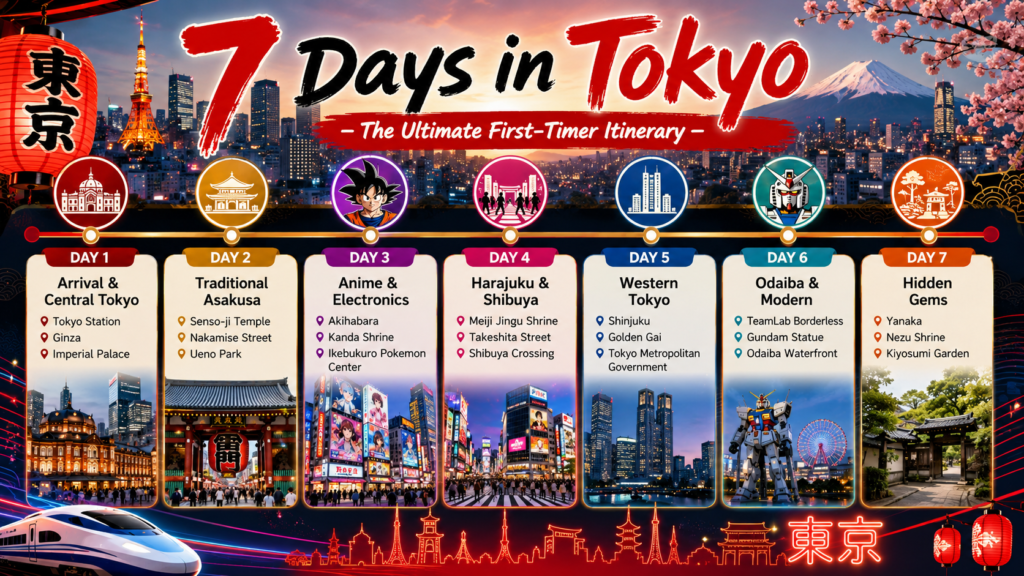
| Day | Focus | Suggested Areas |
|---|---|---|
| 1 | Arrival and central Tokyo | Tokyo Station, Ginza, Imperial Palace area |
| 2 | Traditional Tokyo | Asakusa, Senso-ji, Ueno |
| 3 | Anime and games | Akihabara, Kanda, Ikebukuro |
| 4 | Harajuku and Shibuya | Meiji Jingu, Harajuku, Shibuya |
| 5 | Western Tokyo | Shinjuku, Shinjuku Gyoen, nearby entertainment areas |
| 6 | Modern waterfront Tokyo | Odaiba and other current waterfront attractions |
| 7 | Quieter neighborhoods | Yanaka, Nezu, Kiyosumi area |
How Can You Make the Itinerary More Flexible?
- Move outdoor activities when the weather is better.
- Reserve timed-entry attractions according to their current booking rules.
- Keep one lighter day if you are traveling with children or after a long international flight.
- Group destinations by neighborhood instead of crossing the city repeatedly.
- Leave open time for shopping, food, or unexpected discoveries.
If you want to expand this Tokyo stay into a broader multi-city trip, our 14-Day Global Itinerary provides a wider framework for combining Tokyo with other major destinations.
What Should You Check Before Leaving for Tokyo?
- Choose accommodation near a convenient railway or subway station.
- Check the current transport options available to your arrival airport.
- Decide whether an IC card or a specific transport pass makes more sense for your itinerary.
- Group attractions by neighborhood.
- Check opening hours and reservation requirements for museums and popular attractions.
- Keep important addresses and travel information available offline.
- Check current entry requirements for Japan based on your passport and circumstances.
- Allow extra time for large stations, walking, and transfers.
- Keep your itinerary flexible enough to handle weather and unexpected closures.
Conclusion
Tokyo is easier to enjoy when you stop trying to experience everything at once. Understanding the railway system, choosing a practical base, and organizing attractions by neighborhood can make a major difference to the pace of a trip.
For first-time visitors, a balanced itinerary can combine traditional sites such as Senso-ji and Meiji Jingu with modern districts such as Shibuya, Shinjuku, and Akihabara. Add good food, time for shopping, and a few quieter neighborhoods, and you can experience several sides of Tokyo without turning the trip into a race between stations.
Before departure, verify current transport fares, attraction schedules, event information, accommodation conditions, and Japanese entry requirements through official sources. That final check is especially important for information that can change after an article is published.