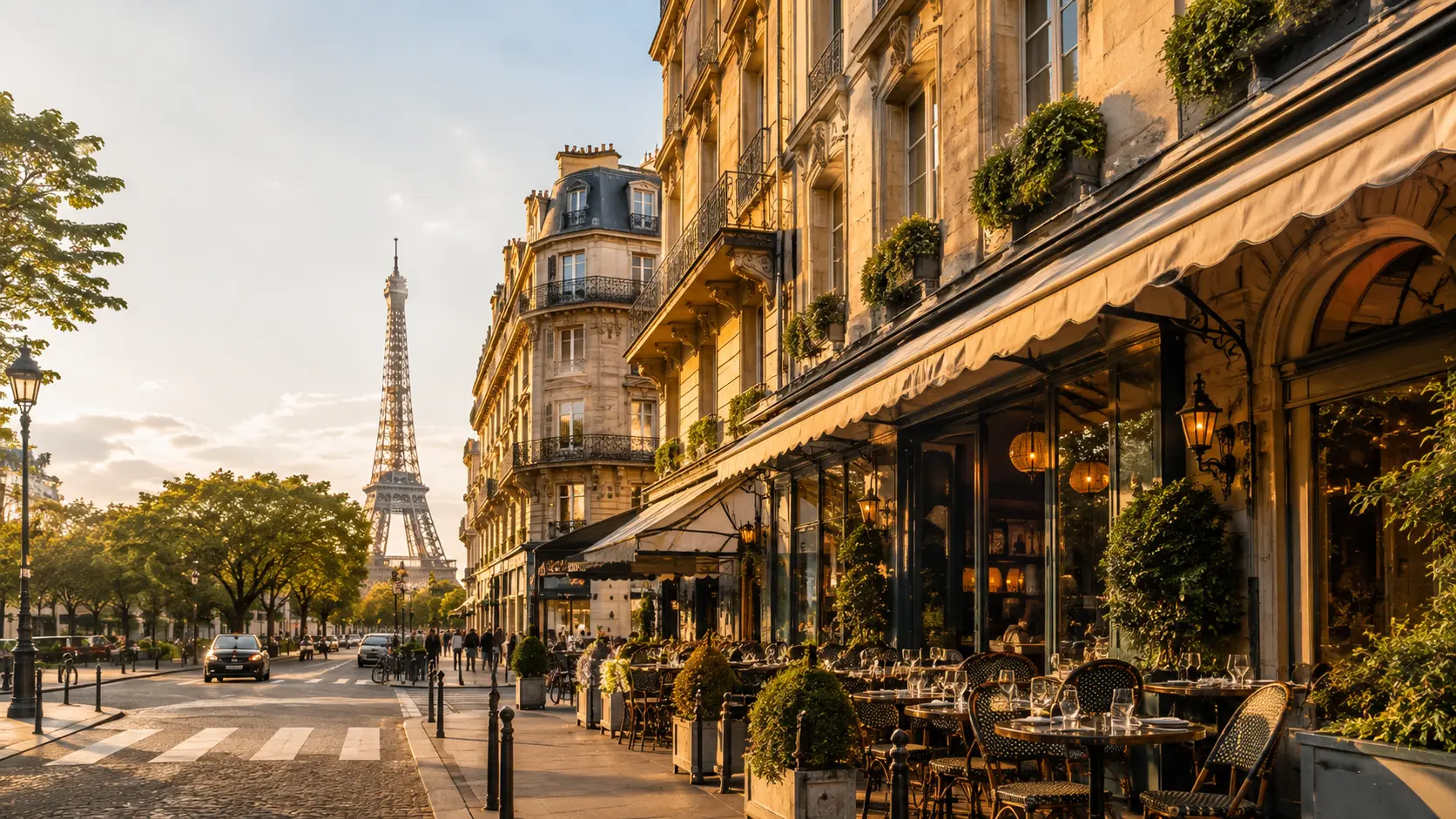
Paris combines historic architecture, major museums, renowned restaurants, neighborhood cafés, and a wide range of accommodation styles. For a first visit, the challenge is not finding things to do but deciding how to organize them without making the trip unnecessarily rushed.
This guide focuses on practical choices for first-time visitors, including where to stay, different ways to experience Paris, luxury hotels worth considering, cafés and food experiences, everyday French etiquette, transportation, safety, and a manageable three-day itinerary.
Different Ways to Experience Paris
Paris does not have to be experienced in one particular way. Some travelers may prioritize museums and historic landmarks, others may prefer cafés, neighborhoods, food, shopping, or a slower pace of walking and everyday city life. Accommodation can also range from a practical central base to a boutique property or a luxury hotel.
The useful question is not which travel style is the “right” way to visit Paris, but which combination of experiences fits your time, interests, comfort preferences, and budget. The luxury hotels discussed below are one option for travelers who specifically want that style of stay; they are not a requirement for enjoying Paris.
- Culture and history: Prioritize museums, monuments, architecture, and historic neighborhoods.
- Food and local atmosphere: Build the trip around cafés, bakeries, markets, restaurants, and neighborhood walks.
- Comfort and premium stays: Choose a higher-end hotel and add experiences that match a more luxurious travel style.
- Balanced first visit: Combine major landmarks with local neighborhoods and unstructured time rather than filling every hour.
Prices, opening hours, transport fares, and entry requirements can change. Treat prices mentioned in this guide as general planning references and verify current information with the official hotel, attraction, transport operator, or government source before booking.
Introduction: Why Paris Captivates First-Time Visitors
Paris can feel overwhelming on a first visit because many of its best-known attractions are spread across different neighborhoods. The Eiffel Tower, Louvre Museum, Notre-Dame, Montmartre, Saint-Germain-des-Prés, and the Champs-Élysées each offer a different side of the city.
The easiest way to make a first trip more enjoyable is to group activities by area, leave time for walking, and avoid trying to see every major attraction in a single day. Paris is particularly well suited to travelers who combine planned visits with unstructured time for cafés, parks, markets, and neighborhood streets.
Three practical areas can shape a comfortable first visit:
- Accommodation: Choose a neighborhood that fits your sightseeing plans, budget, and preferred atmosphere.
- Food and cafés: Mix well-known establishments with neighborhood cafés and bakeries rather than planning every meal around tourist landmarks.
- Cultural awareness: A few simple French phrases and respectful behavior can make everyday interactions smoother.
Choosing the Right Neighborhood: Where to Stay in Paris
Paris has 20 administrative arrondissements, but visitors usually choose accommodation based on a smaller group of central neighborhoods. Location can affect how much time you spend walking, using public transportation, or returning to your hotel between activities.
Neighborhood Comparison
| Area | Atmosphere | Good For | Nearby Highlights |
|---|---|---|---|
| 1st – Louvre / Palais Royal | Central, historic, elegant | First-time sightseeing and museums | Louvre, Tuileries Garden, Palais Royal |
| 4th – Le Marais | Historic, lively, diverse | Food, shopping, walking | Place des Vosges, medieval streets, Hôtel de Ville |
| 6th – Saint-Germain-des-Prés | Classic, literary, relaxed | Cafés, galleries, Left Bank atmosphere | Luxembourg Gardens, Seine, historic cafés |
| 7th – Eiffel Tower / Invalides | Residential, upscale | Landmarks and quieter evenings | Eiffel Tower, Invalides, Seine |
| 8th – Champs-Élysées | Grand, commercial, upscale | Shopping and central attractions | Arc de Triomphe, Champs-Élysées, Avenue Montaigne |
| 9th – Opéra / Grands Boulevards | Busy, central, varied | Shopping, entertainment, restaurants | Opéra Garnier, department stores |
| 16th – Passy / Trocadéro | Residential, quieter | Families and Eiffel Tower access | Trocadéro, Palais de Chaillot, Eiffel Tower views |
For a first trip, the 1st, 4th, 6th, or 7th can be convenient choices because they provide access to many central attractions. The 9th can work well for travelers who prefer a lively area with shopping and entertainment, while the 16th offers a quieter residential setting.
Luxury Hotels in Paris: One Travel Style to Consider
Paris has a wide range of luxury hotels, from historic palace properties to contemporary hotels overlooking the Seine. Instead of choosing a hotel simply because it has a famous name, consider its location, room type, facilities, dining options, and how easily it connects with the places you want to visit.
Ritz Paris
- Location: Place Vendôme in the 1st arrondissement.
- Character: Historic Parisian luxury with a long association with the city’s fashion, arts, and hospitality traditions.
- Known for: Its central location, Bar Hemingway, spa facilities, restaurants, and classic interiors.
- Best suited to: Travelers who value heritage, formal service, and easy access to central Paris.
Shangri-La Paris
- Location: Near Trocadéro in the 16th arrondissement.
- Character: A former private residence with a palace-style setting and views toward the Eiffel Tower from selected rooms and suites.
- Known for: Eiffel Tower views, refined interiors, dining, and a relatively peaceful residential location.
- Best suited to: Couples and travelers who prioritize views and a quieter base.
Hôtel de Crillon, A Rosewood Hotel
- Location: Place de la Concorde in the 8th arrondissement.
- Character: Historic architecture combined with contemporary interiors and hospitality.
- Known for: Its central position, architectural details, dining, and spa facilities.
- Best suited to: Travelers looking for a traditional Paris luxury experience close to major landmarks and shopping areas.
Hôtel Particulier Montmartre
- Location: Montmartre in the 18th arrondissement.
- Character: Small-scale accommodation in a historic residential setting.
- Known for: Its intimate atmosphere, individual design, and proximity to Montmartre’s streets and attractions.
- Best suited to: Travelers who prefer a boutique experience rather than a large traditional hotel.
Cheval Blanc Paris
- Location: Along the Seine near La Samaritaine in the 1st arrondissement.
- Character: Contemporary luxury with a strong focus on design, dining, wellness, and views.
- Known for: Its riverside location, restaurants, spa facilities, and modern interiors.
- Best suited to: Travelers who prefer contemporary design and easy access to central shopping and cultural attractions.
Luxury Hotel Comparison
| Hotel | Area | Main Appeal | Style |
|---|---|---|---|
| Ritz Paris | Place Vendôme | Historic setting and central location | Classic luxury |
| Shangri-La Paris | Trocadéro | Eiffel Tower views from selected rooms | Palace-style |
| Hôtel de Crillon | Place de la Concorde | Historic architecture and central location | Classic and refined |
| Hôtel Particulier Montmartre | Montmartre | Intimate boutique atmosphere | Private and artistic |
| Cheval Blanc Paris | Seine / 1st | Contemporary design and riverside setting | Modern luxury |
Nightly rates can vary significantly by room category, dates, demand, and booking conditions. Check the hotel’s official website or a reputable booking platform for the current rate before making a decision.
Paris Cafés and Local Food Experiences
Café culture is an important part of everyday life in Paris, but not every worthwhile stop needs to be a famous tourist destination. Consider choosing cafés based on the neighborhood you are already exploring and checking the current menu and opening hours before visiting.
Historic Cafés
Le Procope in the 6th arrondissement is a historic restaurant and café associated with important figures from French intellectual and political history. Its setting makes it an interesting stop for visitors combining food with historical sightseeing.
Café des Deux Moulins in Montmartre became internationally recognizable through the film Amélie. It can be included naturally in a Montmartre walking route, particularly for travelers interested in film locations and neighborhood atmosphere.
Specialty Coffee and Artisan Roasters
Holybelly is known for specialty coffee and brunch and can be a useful stop around the 10th arrondissement. Opening hours and service arrangements can change, so check current information before visiting.
Coutume Café is associated with Paris’s specialty coffee scene and has locations in the city. It is a practical option for travelers who want to explore contemporary coffee culture rather than traditional café service.
KB CaféShop in the 9th arrondissement is another specialty coffee option that can fit into a route around Pigalle, Montmartre, and nearby neighborhoods.
Traditional Tea Houses and Sweet Spots
Angelina is well known for its hot chocolate and Mont Blanc pastry. Its Rue de Rivoli location is particularly convenient for visitors combining a stop there with the Tuileries Garden, Louvre area, or nearby museums.
Ladurée is widely associated with French macarons and traditional tea-room experiences. With multiple locations, it can be convenient when you want to add a short pastry stop to an existing sightseeing route.
Café Etiquette
- Greet staff politely when entering, particularly in smaller independent establishments.
- Check the menu before ordering because prices can vary by location and service style.
- Ask whether you should order at the counter or wait for table service.
- If you need to work or stay for an extended period, choose an establishment that clearly accommodates longer stays rather than assuming every café does.
- Service charges and tipping practices differ from those in countries such as the United States, so check the bill rather than automatically adding a large percentage.
Essential Cultural Etiquette for First-Time Visitors
French etiquette does not require visitors to speak fluent French. A few simple habits can make everyday interactions more comfortable and show respect for local customs.
Greetings and Politeness
- Use “Bonjour” when greeting people during the day and “Bonsoir” in the evening.
- Use “S’il vous plaît” when making a polite request and “Merci” when thanking someone.
- “Au revoir” is a simple way to say goodbye when leaving.
- If you need help in English, a polite approach is to begin with a greeting and then ask whether the person speaks English.
Dining and Restaurant Customs
| Situation | Practical Approach |
|---|---|
| Entering | Wait to be seated when the restaurant uses table service. |
| Water | Ask for tap water if you prefer it; in France, restaurants commonly serve tap water on request. |
| Tipping | Service is generally included in restaurant bills. A small additional amount may be left for particularly good service, but tipping practices differ from the United States. |
| Meal times | Many restaurants have defined lunch and dinner service periods. Check opening hours rather than assuming a kitchen is available throughout the afternoon. |
| Paying | Ask for the bill with “L’addition, s’il vous plaît.” |
Public Behavior and Manners
- Let passengers exit the Metro before boarding.
- Keep voices at a reasonable level on public transportation and in residential areas.
- Follow posted photography rules in museums, churches, and other attractions.
- Check dress expectations when visiting religious sites or upscale restaurants.
- Ask permission before taking a close-up photograph of an individual.
Transport and Shopping Etiquette
- Stand to one side of Metro escalators and allow other passengers to pass where appropriate.
- Follow signs and staff instructions at stations and attractions.
- Prices in ordinary shops are generally fixed, so bargaining is not normally expected.
- For museums and attractions, follow rules concerning bags, food, photography, and mobile phones.
Practical Tips: Money, Transport and Safety
Money and Payments
- Currency: Euro (€).
- Cards are widely accepted, but carrying a small amount of cash can be useful for markets, small purchases, or situations where card payment is unavailable.
- When using an ATM, check the exchange-rate and fee options carefully and avoid accepting unnecessary currency-conversion services.
- Travelers from outside the European Union may be eligible for tax-free shopping under certain conditions. Eligibility, minimum purchase requirements, documentation, and refund procedures should be checked with the retailer and official French or EU guidance before purchase.
Getting Around Paris
- Metro and public transport: Often the most practical way to move between neighborhoods. Current fares and ticket products should be checked before travel.
- Walking: Many central attractions can be combined into walking routes, which can also reveal smaller streets, parks, and cafés.
- Bicycles: Public bike services can be useful for longer distances if you are comfortable cycling in city traffic.
- Taxis and ride-hailing: Compare the estimated fare, pickup location, and journey time when deciding between options.
Safety for Tourists
- Keep wallets, phones, and passports secure in crowded tourist areas and on busy public transportation.
- Be cautious around unsolicited petitions, gifts, or approaches involving money.
- Use official ticketing channels for major attractions whenever possible.
- Keep your accommodation address and emergency contact information accessible.
- For emergencies in France, 112 is the European emergency number. Other emergency services can also be reached through dedicated French numbers.
Sample 3-Day Itinerary for First-Time Visitors
This itinerary is designed as a practical framework rather than a fixed schedule. Attraction opening hours, ticket availability, weather, and personal pace can require adjustments.
If you are building a longer multi-city trip, our 14-Day Global Itinerary provides a broader framework for combining major destinations and managing travel time.
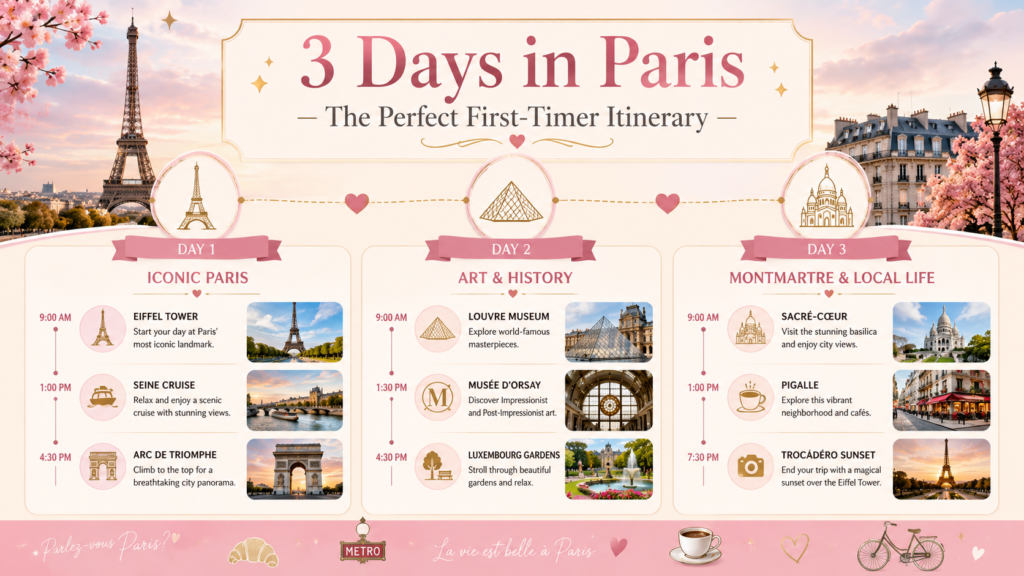
Day 1 – Iconic Paris
- Morning: Visit the Eiffel Tower area and allow enough time for security and access arrangements.
- Lunch: Choose a café or restaurant around the Champ de Mars or nearby neighborhood.
- Afternoon: Take a Seine cruise or walk along the river before continuing toward the Arc de Triomphe.
- Evening: Have dinner in the 7th arrondissement or another neighborhood convenient for your accommodation.
Day 2 – Art and History
- Morning: Visit the Louvre or another major museum. Reserve admission when the attraction requires or recommends timed entry.
- Lunch: Explore a café or restaurant around the Louvre, Palais Royal, or Le Marais.
- Afternoon: Continue toward the Musée d’Orsay or Luxembourg Gardens depending on your interests and energy level.
- Evening: Walk through Saint-Germain-des-Prés and choose a nearby restaurant for dinner.
Day 3 – Montmartre and Local Life
- Morning: Explore Sacré-Cœur Basilica and the surrounding streets of Montmartre.
- Brunch: Choose a café in Montmartre or the nearby 9th arrondissement.
- Afternoon: Walk through Pigalle and explore the neighborhood’s shops, cafés, and streets.
- Evening: Finish with an Eiffel Tower view from Trocadéro if weather and timing allow.
How to Make Your First Paris Trip More Comfortable
- Group attractions by neighborhood: This reduces unnecessary cross-city travel.
- Leave room in the schedule: Paris is enjoyable on foot, and unplanned stops can become part of the experience.
- Book important attractions through official channels: Check current ticket policies before your trip.
- Choose accommodation strategically: A slightly more central hotel can be worthwhile if it reduces daily transportation time.
- Check current information shortly before departure: Museum schedules, transport arrangements, restaurant hours, and entry requirements can change.
Conclusion
A successful first trip to Paris does not require an itinerary packed from morning until night. A better approach is to choose a convenient neighborhood, prioritize a few major attractions, and leave enough time to experience cafés, parks, streets, and local neighborhoods along the way.
Whether you choose a historic luxury hotel, a boutique property in Montmartre, or a centrally located accommodation, the most useful decision is the one that matches your travel style and sightseeing plans. Add a few basic French phrases, pay attention to local etiquette, and verify current attraction and transport information before departure.