Prices, schedules, reservation requirements, and mountain railway fares can change by season and operator. The examples in this guide are intended for trip planning. Check the official SBB and individual railway operator websites for current fares, operating conditions, and reservation requirements before booking.
How Can You Plan a Switzerland Trip by Train?
Switzerland is particularly well suited to rail travel. Major cities, lakeside towns, alpine destinations, and many mountain excursions can be connected using trains, buses, boats, and mountain railways.
For first-time visitors, the challenge is usually not finding a train. The more important decisions are choosing the right combination of destinations, tickets, scenic services, and mountain excursions for your available time and budget.
This guide explains how the Swiss rail system works, how to compare ticket options, how to build a practical rail itinerary, which scenic experiences you can consider, and what to check before booking.
Why Explore Switzerland by Train?
Rail travel makes it possible to move between major destinations without dealing with mountain roads, parking, or changing vehicles for every part of the journey. It also provides direct access to many city centers and convenient connections to buses, boats, and mountain railways.
- Convenient connections: Trains connect major cities and many smaller destinations throughout Switzerland.
- Scenic journeys: Several routes are especially popular for their alpine, lake, and valley landscapes.
- Easy transfers: Rail services connect with local buses, boats, and mountain transport.
- Flexible planning: Travelers can combine regular trains with selected panoramic or mountain railway experiences.
- Central stations: Many railway stations are located close to hotels, attractions, and local public transport.
What Should You Know About the Swiss Rail System?
Swiss public transport can initially look complicated because several operators and types of service are involved. For most visitors, however, the basic concept is straightforward: use SBB to search connections, then check whether your chosen ticket or pass covers the journey.
When Are Regular Trains the Practical Choice?
InterCity and regional services are useful for moving between cities and towns. Regular journeys generally do not require an advance seat reservation, although optional reservations may be available on selected services.
When Should You Consider Panoramic and Scenic Trains?
Special services such as the Glacier Express and Bernina Express are designed around the journey itself. A valid Swiss Travel Pass can cover eligible travel, but reservations and surcharges may still apply. Always check the operator’s current rules before traveling.
How Are Mountain Railways Different From Regular Trains?
Mountain railways and cable cars are often treated separately from ordinary rail journeys. A Swiss Travel Pass provides a discount on many mountain excursions, but the exact benefit depends on the destination and service.
This distinction matters when calculating your trip because a rail pass that covers your city-to-city journey does not necessarily mean every mountain excursion is fully included.
Which Switzerland Rail Pass or Ticket Option Fits Your Trip?
The best ticket depends on how often you will travel, how long you will stay, and how many mountain excursions you plan to take. A pass is not automatically the cheapest option for every itinerary, so comparing the journeys you actually expect to make is worthwhile.
What Does the Swiss Travel Pass Offer?
The Swiss Travel Pass is available to eligible travelers living outside Switzerland and Liechtenstein. For adults aged 25 and over, the 2026 second-class prices are CHF 254 for 3 days, CHF 309 for 4 days, CHF 399 for 6 days, CHF 439 for 8 days, and CHF 499 for 15 days. Prices are listed by SBB as valid through December 31, 2026, subject to change.
| Pass | 2026 Adult 2nd Class | Useful For |
|---|---|---|
| 3 days | CHF 254 | Short multi-city trips |
| 4 days | CHF 309 | Short scenic itineraries |
| 6 days | CHF 399 | One-week style trips |
| 8 days | CHF 439 | Longer rail itineraries |
| 15 days | CHF 499 | Extended travel across Switzerland |
The Swiss Travel Pass provides unlimited travel by train, bus, boat, and eligible panoramic trains during its validity period, while reservations and surcharges are excluded. It also includes local public transport in more than 90 towns and cities, free admission to more than 500 museums, and up to 50% discounts on many mountain railways.
When Can Swiss Travel Pass Flex Be Useful?
The Flex version provides 3, 4, 6, 8, or 15 travel days within one month rather than requiring consecutive travel days. This can be useful if you plan to stay several nights in one destination between rail-heavy travel days.
When Should You Compare the Swiss Half Fare Card?
The Swiss Half Fare Card reduces eligible fares by half for train, bus, boat, most mountain railways, and public transport in many Swiss towns and cities. It can be worth comparing when you are taking fewer long-distance journeys but expect several paid mountain excursions.
When Do Point-to-Point and Supersaver Tickets Make Sense?
For travelers with a small number of fixed journeys, individual tickets can sometimes make more sense than a nationwide pass. SBB also offers discounted tickets on selected connections, subject to availability and travel conditions.
How Can You Decide Which Ticket Option Fits Your Itinerary?
Instead of choosing a pass first and building your trip around it, start with the destinations and journeys you actually want. Then compare the expected rail costs with the available pass benefits.
When Might the Swiss Travel Pass Suit You?
- You are visiting several regions during a relatively short trip.
- You expect to use trains, buses, boats, and local public transport frequently.
- You want access to the museums and included benefits of the pass.
- You prefer simpler ticket management.
When Might the Half Fare Card Suit You?
- Your itinerary includes a mixture of paid transport and mountain excursions.
- You do not need unlimited travel every day.
- You are comfortable buying individual tickets as you travel.
When Might Individual Tickets Be More Practical?
- Your trip includes only a few longer journeys.
- You have a short itinerary centered around one or two destinations.
- You find suitable discounted fares for your fixed travel dates.
The important point: there is no single pass that automatically fits every Switzerland trip. Your route, travel frequency, mountain excursions, and flexibility should determine the comparison.
What Could a Practical 10-Day Switzerland Rail Itinerary Look Like?
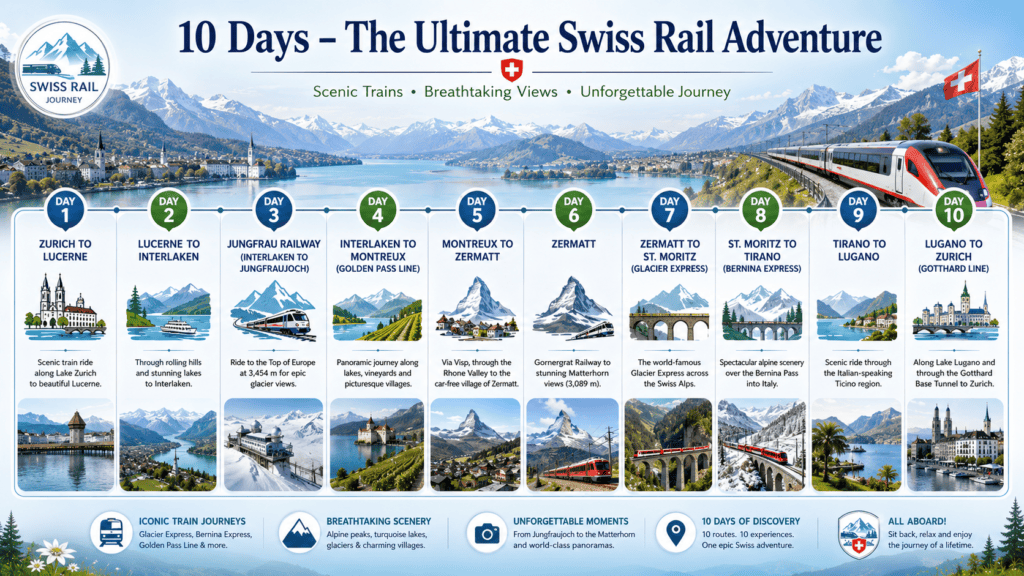
The following route is an example rather than a fixed formula. It combines several well-known destinations and scenic rail experiences while keeping the journey reasonably structured.
| Day | Route | Suggested Focus |
|---|---|---|
| 1 | Zurich → Lucerne | Lake Lucerne and historic center |
| 2 | Lucerne → Interlaken | Scenic journey and Interlaken |
| 3 | Interlaken → Jungfraujoch | Mountain excursion |
| 4 | Interlaken → Montreux | GoldenPass route and Lake Geneva |
| 5 | Montreux → Zermatt | Valais scenery and Zermatt |
| 6 | Zermatt | Gornergrat or another mountain excursion |
| 7 | Zermatt → St. Moritz | Glacier Express |
| 8 | St. Moritz → Tirano | Bernina route |
| 9 | Tirano → Lugano | Southern Switzerland |
| 10 | Lugano → Zurich | Return journey |
Shorter option: For five days, consider Zurich → Lucerne → Interlaken → Montreux → Zermatt → Zurich and select fewer mountain excursions rather than trying to reproduce the full 10-day route.
If you are planning this route as a family, see our Five-Day Family-Friendly Switzerland Rail Tour Itinerary with Affordable Swiss Pass Hotels for a more family-focused example.
This itinerary should be treated as a framework. Travelers can remove destinations, add nights, or select different mountain excursions depending on their interests and available time.
Which Scenic Rail Experiences Could You Add?
Scenic rail experiences do not all need to be added to the same trip. Think of them as options that can replace or complement parts of your main route.
Could the GoldenPass Route Fit Your Journey?
The GoldenPass route connects central Switzerland with the Lake Geneva region and provides a varied journey through lakes, mountain landscapes, villages, and vineyards. The route can be particularly useful when traveling between Lucerne, Interlaken, and Montreux.
Check the current timetable and reservation requirements for the specific GoldenPass service you plan to use. Not every train on the route has the same reservation conditions.
When Would You Choose the Glacier Express?
The Glacier Express connects Zermatt and St. Moritz and is one of Switzerland’s best-known panoramic rail journeys. Because it is a dedicated scenic service, travelers should check both the ticket validity and the separate reservation or surcharge requirements before booking.
A Swiss Travel Pass can cover the eligible journey itself, but it does not automatically eliminate reservations or surcharges.
When Would You Choose the Bernina Express?
The Bernina route links the Engadin region with Tirano in Italy and is known for its high-alpine scenery, viaducts, and dramatic changes in landscape. Because the service crosses the Swiss-Italian border, check the current operator information for tickets, reservations, and onward connections.
When Does the Jungfraujoch Railway Make Sense?
Jungfraujoch reaches 3,454 meters above sea level and is one of the most popular mountain excursions in the Jungfrau region. The cost is separate from many ordinary rail journeys, although eligible passes can provide discounts.
For 2026, Jungfrau Railways lists special connecting-ticket arrangements for travelers with the Jungfrau Travel Pass, including a CHF 89 price from May 1 through October 31, including the required seat reservation during that period. Conditions differ depending on the pass and travel date.
When Would You Choose the Gornergrat Railway?
From Zermatt, the Gornergrat Railway provides access to high-altitude viewpoints with views toward the Matterhorn and surrounding peaks. Because mountain railway prices and discounts vary, compare the current fare with the benefits of your chosen pass before purchasing.
Why Consider the Historic Gotthard Scenic Route?
The historic Gotthard route offers an alternative to simply traveling through the modern Gotthard Base Tunnel. Travelers interested in landscapes and railway history can compare the faster connection with the more scenic mountain route when schedules allow.
Planning principle: choose scenic services because they fit the route and experience you want—not simply because they are famous. Adding every panoramic journey can make a rail itinerary unnecessarily complicated.
How Can You Control Your Switzerland Rail Budget?
Switzerland can become expensive quickly when accommodation, food, transportation, and mountain excursions are combined. The most useful approach is to calculate the major categories separately rather than relying on one fixed trip price.
How Should You Compare a Rail Pass With Individual Tickets?
Start by listing every major journey in your itinerary. Check the current SBB fare for each journey, then compare the total with the cost and benefits of the available passes. This is more reliable than assuming a pass will always be cheaper.
When Should You Look for Discounted Tickets?
If your travel dates and departure times are fixed, check SBB for available discounted fares. These fares can have more restrictive conditions than flexible tickets, so read the terms before purchasing.
How Can Your Hotel Location Affect Your Budget?
Choosing accommodation within practical walking distance of a station can reduce transfers and make luggage management easier. This is especially useful when changing cities frequently.
For more ideas on accommodation near major rail connections, see our guide to affordable family-friendly hotels near Western European train stations.
How Can You Control Food Costs?
Switzerland can be expensive for dining out. Buying breakfast items, snacks, or picnic ingredients from supermarkets can help control the daily food budget without requiring a strict meal plan.
Why Should You Budget Mountain Excursions Separately?
Mountain railways can represent a significant part of the trip budget. Before purchasing a pass, identify which mountain excursions you actually want to take and check whether your pass provides free travel, a partial discount, or no discount.
What Should an 8-Day Switzerland Budget Include?
Rather than presenting a single fixed trip price, use the following framework. Actual costs depend heavily on accommodation, restaurants, mountain excursions, travel dates, and the ticket combination selected.
| Category | What to Estimate |
|---|---|
| Rail pass or tickets | Compare SBB fares with Swiss Travel Pass or Half Fare Card options |
| Accommodation | Price per night × number of nights |
| Mountain excursions | Jungfraujoch, Gornergrat, Pilatus, Rigi, or other selected destinations |
| Food | Breakfast, lunch, dinner, drinks, and snacks |
| Local transport | City transport not already covered by your chosen pass |
| Miscellaneous | Lockers, souvenirs, optional activities, and unexpected expenses |
How Should You Build and Book Your Switzerland Rail Trip?
Step 1: Build the Route Before Buying the Pass
Choose your main destinations first. A route such as Zurich → Lucerne → Interlaken → Montreux → Zermatt can form a practical foundation before adding optional scenic or mountain excursions.
Step 2: Check Connections on SBB
Use the official SBB website or SBB Mobile to compare departure times, connections, journey durations, and available fares. SBB provides travel information and ticket options specifically for international visitors.
Step 3: Check Scenic Train Requirements Separately
For Glacier Express, Bernina Express, and other dedicated scenic services, check the operator’s current reservation rules separately from your main rail pass. A pass covering the journey does not necessarily cover the reservation or surcharge.
Step 4: Leave Some Flexibility for Mountain Weather
Mountain weather can affect visibility and operating conditions. If possible, avoid making every day dependent on a single mountain viewpoint. Keeping one flexible day can make the itinerary more comfortable.
Step 5: Check Conditions Before Major Excursions
Check the latest train information, weather, and mountain operating conditions before leaving for a major excursion. Conditions at high altitude can differ significantly from those in nearby cities.
What Should You Pack for a Switzerland Rail Trip?
- Pack light: A manageable suitcase is much easier when changing trains or staying near stations.
- Keep essentials accessible: Store passports, tickets, medication, chargers, and valuables where they are easy to reach.
- Check platform information: Confirm the departure platform and train number before boarding.
- Allow transfer time: If traveling with children or heavy luggage, choose connections with enough time to change trains comfortably.
- Dress in layers: Temperatures can be very different between Swiss cities and high-altitude destinations.
- Check accessibility requirements: Travelers with mobility needs should check station and train accessibility for their specific route before departure.
When Is a Good Time to Take a Swiss Rail Trip?
There is no single best season for every itinerary. Summer provides long daylight hours and access to many mountain destinations, while spring and autumn can offer a different atmosphere and potentially different accommodation availability. Winter is particularly attractive for snow-focused travel but requires more attention to weather and operating conditions.
If a mountain viewpoint is a major reason for your trip, build some flexibility into the schedule so poor visibility on one day does not ruin the entire itinerary.
What Should You Check Before You Travel?
- Confirm your passport and entry requirements.
- Check the latest SBB timetable and fares.
- Compare individual tickets with pass options.
- Confirm whether scenic trains require reservations or surcharges.
- Check mountain railway discounts included with your pass.
- Reserve accommodation near convenient transport connections.
- Check weather and mountain operating conditions.
- Download or prepare access to your tickets and booking confirmations.
- Pack layers and comfortable footwear.
- Keep your itinerary flexible enough to handle weather or transport changes.
Conclusion
Traveling through Switzerland by train can be a practical way to combine major cities, alpine destinations, lakes, and scenic railway experiences in one trip. The key is not to choose every famous route, but to build an itinerary that matches your available time, budget, and interests.
Start with the destinations that matter most, compare current SBB fares with the available passes, and treat panoramic and mountain railway reservations as separate parts of the planning process. With those basics in place, you can create anything from a compact five-day route to a longer journey through several regions of Switzerland.
For current fares, schedules, pass conditions, and reservation requirements, always verify the details with SBB and the relevant railway operator before finalizing your trip.