Travel information such as admission fees, transport schedules, visa requirements, opening hours, and seasonal conditions can change. Check official Korean government, tourism, transport, and attraction websites before your trip, especially close to your departure date.
South Korea Travel Guide: How to Plan Your First Trip
South Korea combines modern cities, historic architecture, mountain landscapes, coastal destinations, and a distinctive food culture. For first-time visitors, Seoul provides an easy starting point, while Gyeongju, Busan, and Jeju Island offer different travel experiences.
This guide focuses on practical travel planning. It helps you decide when to go, what to prepare before departure, how to move between destinations, which regions may fit your available time, and how to build a practical itinerary.
What Should You Know About South Korea Before Planning Your Trip?
| Detail | Practical Information |
|---|---|
| Capital | Seoul |
| Currency | South Korean won (KRW) |
| Language | Korean |
| Time Zone | Korea Standard Time (KST), UTC+9 |
| Recommended Trip Length | About 7–14 days depending on the number of regions visited |
| Major Transport | Subway, buses, intercity trains, KTX, SRT, domestic flights, and taxis |
| Popular First-Trip Route | Seoul → Gyeongju → Busan |
Which Season Fits the South Korea Trip You Want?
South Korea has four distinct seasons, and each offers a different travel experience. Instead of looking for one universal “best” season, choose according to the activities and scenery you want to experience.
| Season | Typical Period | Why Visit | Planning Considerations |
|---|---|---|---|
| Spring | March–May | Flowers, parks, cultural sightseeing | Popular periods can be busy |
| Summer | June–August | Beaches, greenery, festivals, island travel | Hot, humid, and rainy conditions are possible |
| Autumn | September–November | Cooler weather and autumn foliage | Popular foliage locations can become crowded |
| Winter | December–February | Snow, winter scenery, skiing | Cold weather requires appropriate clothing |
Planning tip: Choose your travel season according to the experiences you want rather than relying on one universal “best” month. Check the forecast for each destination shortly before your trip.
What Entry Requirements Should You Check Before Traveling?
Entry requirements for South Korea depend on your nationality, passport, purpose of travel, and the rules in effect on your travel date. Travelers should verify the requirements that apply specifically to their passport before departure.
- Check whether you need a visa for your nationality and purpose of travel.
- Check whether you need a Korea Electronic Travel Authorization (K-ETA).
- Some nationalities and regions may be temporarily exempt from K-ETA requirements, so do not rely on an old travel checklist.
- Confirm the current passport and entry requirements for your nationality.
- Review customs rules before bringing food, agricultural products, medicines, or other regulated items.
Important: Entry and K-ETA policies can change. Use official Korean government and K-ETA sources to verify the rules that apply to you immediately before traveling.
How Should You Build a South Korea Travel Budget?
There is no single daily budget that fits every South Korea trip. Costs depend on accommodation, season, transport, dining choices, shopping, and the number of paid attractions you visit.
| Category | Budget Approach | What Can Increase the Cost? |
|---|---|---|
| Accommodation | Hostels, guesthouses, budget hotels | Central locations, weekends, peak seasons, larger rooms |
| Food | Markets, local restaurants, casual meals | Premium restaurants, cafés, international cuisine |
| Transport | Subway, buses, standard intercity transport | High-speed rail, taxis, domestic flights, private transfers |
| Attractions | Public spaces and selected paid attractions | Special exhibitions, tours, performances, theme parks |
| Shopping | Set a separate shopping allowance | Cosmetics, fashion, electronics, K-pop merchandise |
For an accurate trip budget, check current accommodation and transportation prices for your actual dates. Exchange rates can also change, so keeping a small financial buffer is sensible.
Which Travel Apps and Tools Can Make Planning Easier?
- Naver Map: Useful for local maps, directions, businesses, and public transportation information.
- KakaoMap: Another useful mapping option for navigating Korean cities.
- Kakao T: Useful for taxi and mobility services where available.
- Papago: Helpful for translating Korean text, signs, menus, and conversations.
- VisitKorea: Useful for tourism information and destination planning.
- KORAIL: Useful for checking railway information and reservations.
Google Maps can still be useful for general information, but local mapping and transport applications can be helpful when detailed Korean-language navigation is required.
Which Transport Option Fits Your South Korea Route?
South Korea has an extensive public transportation network. The best option depends on whether you are traveling within one city or moving between regions.
When Should You Consider KTX and Intercity Trains?
KTX high-speed trains connect several major cities and can be useful for travelers building a multi-city itinerary. Other services, including SRT and conventional trains, provide additional options depending on the route.
- Check the departure station carefully before booking.
- Use official railway or authorized booking channels.
- Train availability can become tighter during holidays and busy travel periods.
- Travelers making several qualifying train journeys can investigate whether a KORAIL Pass fits their itinerary.
When Can Intercity Buses Be Useful?
Express and intercity buses connect destinations that may not have a convenient direct rail connection. They can be especially useful for regional travel and smaller cities.
When Do Domestic Flights Make Sense?
Domestic flights can be useful for longer journeys, particularly when traveling between the mainland and Jeju Island. Compare the complete journey time, including airport transfers and check-in, rather than considering flight duration alone.
How Should You Move Around Korean Cities?
- Subway: Particularly useful in Seoul and Busan.
- City buses: Helpful for destinations beyond convenient subway stations.
- Taxis: Useful when carrying luggage or traveling to locations with limited public transportation.
- Transportation cards: A rechargeable card can simplify everyday journeys depending on the services and cities you use.
What Can You Experience in Seoul?
Seoul combines historic neighborhoods, royal palaces, markets, museums, shopping districts, restaurants, and an extensive public transportation network. It is a practical base for a first visit to South Korea.
Where Can You Explore Seoul’s Royal and Historic Side?
- Gyeongbokgung Palace: A major Joseon-era palace complex and an important destination for travelers interested in Korean history and architecture.
- Changdeokgung Palace: Known for its historic architecture and garden areas.
- Bukchon Hanok Village: A residential area with traditional Korean houses. Visitors should remember that people still live in the neighborhood and should keep noise levels respectful.
- Insadong: Known for traditional crafts, galleries, tea houses, and cultural products.
What Can You See in Modern Seoul?
- N Seoul Tower: A popular viewpoint over the capital.
- Dongdaemun Design Plaza: A distinctive contemporary landmark and event venue.
- Starfield Library: A large public reading and photography space inside COEX.
- Hongdae: Known for youth culture, music, cafés, shopping, and nightlife.
- Myeongdong: A busy shopping and dining district, particularly popular for cosmetics and casual food.
Where Can You Explore Korean Food in Seoul?
Seoul offers everything from traditional markets and neighborhood restaurants to modern Korean cuisine. A balanced food itinerary can include market food, casual restaurants, cafés, and one or two meals focused on a particular Korean specialty.
- Gwangjang Market: Known for traditional market foods and casual dining.
- Myeongdong: Convenient for street snacks and quick meals while sightseeing.
- Hongdae: Offers a broad selection of casual restaurants, cafés, and evening food options.
- Itaewon: A diverse dining district with Korean and international cuisines.
Popular dishes to look for include bibimbap, samgyeopsal, kimchi jjigae, naengmyeon, tteokbokki, and Korean-style fried chicken. Travelers with allergies or dietary restrictions should ask restaurants about ingredients before ordering.
Which Day Trips Can You Add From Seoul?
- Suwon Hwaseong: A historic fortress complex that can be visited as a day trip from Seoul.
- DMZ area: Authorized tours are available, but access and itineraries can change because of security conditions.
- Nami Island: A popular excursion for travelers interested in landscaped paths and seasonal scenery.
Why Add Gyeongju to a South Korea Itinerary?
Gyeongju was the capital of the Silla Kingdom for centuries and contains many important historic and archaeological sites. It provides a useful contrast to the modern character of Seoul.
Bulguksa Temple
Bulguksa is an important Buddhist temple complex associated with the Silla period. Its stone architecture, pagodas, and surrounding landscape make it a major stop for visitors exploring Gyeongju’s heritage.
Seokguram Grotto
Seokguram Grotto is a historic Buddhist site in the hills above Gyeongju and is associated with Bulguksa. Visitors should follow the current photography and visitor rules displayed at the site.
Daereungwon and Cheomseongdae
Daereungwon contains large Silla-era burial mounds, while Cheomseongdae is a historic astronomical observatory. Both sites help visitors understand the historical importance of central Gyeongju.
Donggung Palace and Wolji Pond
The palace site and pond are popular stops in Gyeongju, particularly later in the day. Check current opening information before visiting because operating conditions can change.
What Makes Busan Different From Seoul?
Busan offers a different experience from Seoul, with beaches, seafood markets, hillside neighborhoods, temples, and coastal scenery.
- Haeundae Beach: One of Busan’s best-known coastal areas.
- Gwangalli Beach: Known for views toward Gwangan Bridge.
- Jagalchi Market: A major seafood market area.
- Gamcheon Culture Village: A hillside neighborhood known for colorful buildings and art installations.
- Haedong Yonggungsa: A coastal Buddhist temple complex with a different setting from inland temples.
When Does Jeju Island Make Sense for Your Trip?
Jeju is a volcanic island known for coastal scenery, hiking, geological sites, and local food. It can be a good addition to a longer itinerary, but the extra travel time should be considered when planning a short trip.
- Seongsan Ilchulbong: A volcanic tuff cone and one of Jeju’s best-known natural landmarks.
- Hallasan: South Korea’s highest mountain and an important hiking destination.
- Lava tube systems: Jeju has several volcanic cave sites associated with its geological heritage. Check current access before visiting.
- Local food: Jeju has regional ingredients and dishes that differ from mainland Korean cuisine.
If you have around seven days, concentrating on Seoul, Gyeongju, and Busan can create a more relaxed mainland itinerary. Add Jeju when you have enough time for the additional transportation.
What Korean Etiquette Should Travelers Know?
Travelers do not need to memorize every Korean social custom, but a few simple habits can make everyday interactions smoother.
- Use polite greetings and follow the lead of the person you are speaking with.
- Remove shoes when entering places where visitors are asked to do so.
- Use both hands when giving or receiving something in more formal situations.
- Avoid placing chopsticks upright in a bowl of rice, as this can resemble funeral practices.
- Keep noise levels reasonable on public transportation and in quiet cultural or religious spaces.
- Follow photography restrictions at museums, temples, exhibitions, and other attractions.
- Tipping is generally not a standard expectation in everyday Korean dining, but always follow the policy of the specific business.
What Should You Pack for South Korea?
- Comfortable walking shoes for city sightseeing and historic districts.
- Weather-appropriate layers based on your travel season.
- A compact rain jacket or umbrella when rain is likely.
- A portable charger for long sightseeing days.
- A suitable rechargeable transportation card or local payment option.
- Required medication and travel documentation.
- A small day bag that is comfortable for public transportation and walking.
What Planning Mistakes Should You Avoid in South Korea?
- Trying to cover the entire country: Choose a few regions instead of spending most of the trip in transit.
- Relying on one navigation app: Keep a local mapping option available.
- Assuming entry requirements never change: Check official sources before departure.
- Using outdated transport information: Train schedules, routes, and ticketing systems can change.
- Ignoring travel time: Major cities can be large, and transfers between attractions can add up.
- Overloading the itinerary: Leave time for meals, shopping, rest, and unexpected discoveries.
What Could a Practical 10-Day South Korea Itinerary Look Like?
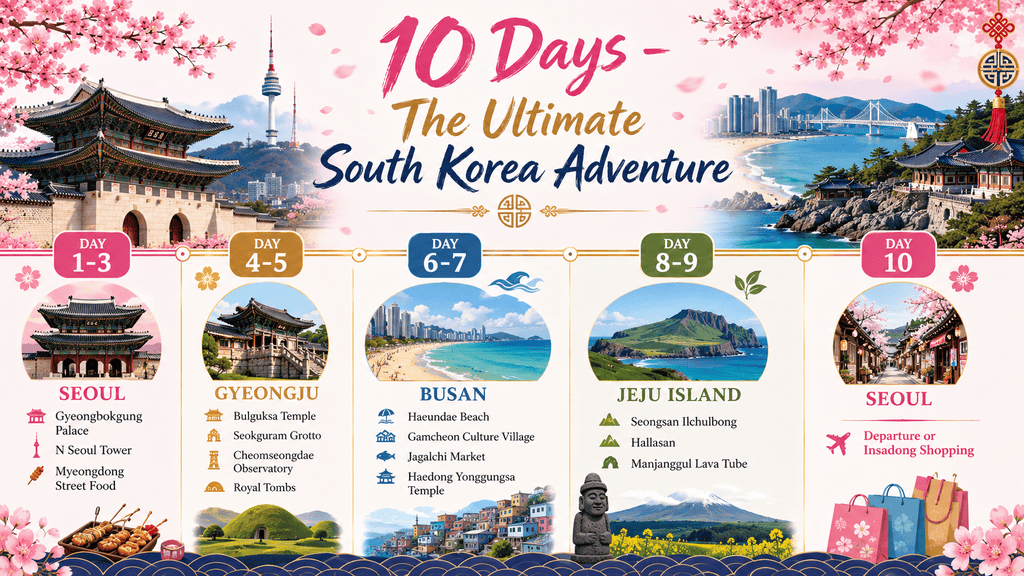
| Days | Destination | Suggested Focus |
|---|---|---|
| 1–3 | Seoul | Palaces, Bukchon, Insadong, markets, shopping, and selected modern landmarks |
| 4–5 | Gyeongju | Bulguksa, historic sites, royal tombs, museums, and evening heritage areas |
| 6–7 | Busan | Haeundae, Gwangalli, Gamcheon, Jagalchi, and coastal attractions |
| 8–9 | Jeju or additional mainland time | Choose Jeju for nature or stay on the mainland for a slower itinerary |
| 10 | Seoul | Return, shopping, final sightseeing, and departure preparation |
How Can You Adjust the Itinerary to Fit Your Available Time?
- 7 days: Focus on Seoul, Gyeongju, and Busan. Skip Jeju unless it is your main priority.
- 10 days: Use the route above for a balanced introduction to several regions.
- 14 days: Add Jeju, more time in Seoul, or another regional destination instead of rushing between cities.
What Should You Check Before Leaving for South Korea?
- Check visa and K-ETA requirements for your nationality and travel dates.
- Confirm passport and entry requirements before departure.
- Choose two or three main regions rather than trying to see everything.
- Check current train and accommodation availability before finalizing your itinerary.
- Install useful navigation and translation apps before arriving.
- Keep your itinerary flexible enough to account for weather and transport changes.
- Respect local neighborhoods, cultural sites, and photography rules.
Conclusion
South Korea offers a useful combination of modern city life, historic sites, regional food, nature, and extensive public transportation. Seoul provides a strong starting point, while Gyeongju adds historical depth and Busan introduces a coastal side of the country. Jeju can be added when you have enough time for a slower, nature-focused trip.
The best itinerary is not necessarily the one with the most destinations. Allow enough time to explore neighborhoods, eat local food, visit cultural sites, and adjust your plans when weather or transportation conditions change.
Before you travel, verify current entry requirements, transportation schedules, attraction information, and local conditions through official sources.
Planning a wider multi-destination trip? Our 14-Day Global Itinerary provides another framework for fitting major destinations into a limited travel window.