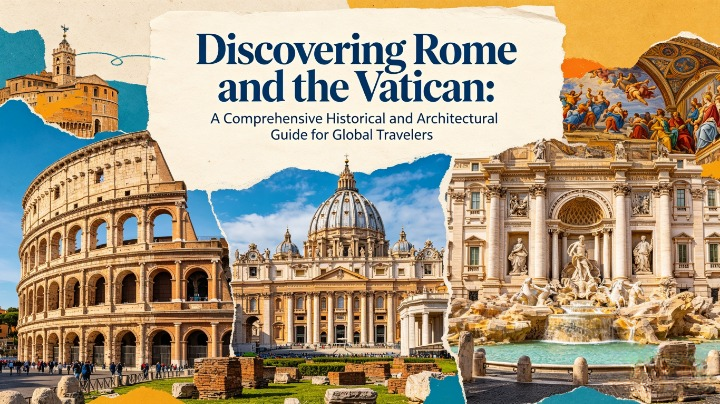
Ticket prices, opening hours, reservation requirements, transport schedules, and restaurant prices can change. Verify current information with official attraction, transport, or venue sources before your trip.
Rome and Vatican City at a Glance
Rome combines ancient archaeological sites, Renaissance and Baroque architecture, religious landmarks, museums, lively neighborhoods, and everyday Italian city life. Within the city, travelers can also visit Vatican City, an independent sovereign state surrounded by Rome.
A trip can range from a short city break focused on the major monuments to a week-long visit that includes museums, historic neighborhoods, food experiences, parks, and quieter archaeological sites.
Planning a wider European trip? Our Europe Backpacking Manual explains how to approach a multi-country journey with practical route, budget, and safety considerations.
| Detail | Practical Information |
|---|---|
| Location | Rome, Lazio, central Italy |
| Country | Italy |
| Currency | Euro (€) |
| Language | Italian; English is commonly used in tourist areas |
| Vatican highlights | St. Peter’s Basilica, Vatican Museums, Sistine Chapel, St. Peter’s Square |
| Ancient Rome highlights | Colosseum, Roman Forum, Palatine Hill, Pantheon |
| Suggested duration | 5–7 days for a broad first visit |
The best itinerary depends on your interests. History-focused travelers may want more archaeological sites, while art lovers may prefer additional museum time. Families and travelers who prefer a slower pace may want fewer major attractions each day.
Why Should You Plan Rome Around Your Interests?
Rome offers more historical and cultural attractions than most travelers can comfortably cover in a few days. Instead of trying to see everything, begin by deciding what matters most to you.
- Ancient history: Focus more time on the Colosseum, Roman Forum, Palatine Hill, and other archaeological sites.
- Art and museums: Allow additional time for the Vatican Museums and other collections.
- Architecture: Combine ancient, Renaissance, and Baroque landmarks with neighborhood walks.
- Food and local life: Leave more room for markets, restaurants, cafés, and neighborhood exploration.
- A slower family trip: Reduce the number of major attractions scheduled each day.
This approach makes it easier to build an itinerary around the experience you actually want rather than treating every famous landmark as mandatory.
What Should You Know About Rome’s History Before Visiting?
You do not need to study Roman history in depth before visiting, but a little context can make the city’s monuments easier to understand.
From Early Rome to the Republic
Roman tradition traditionally dates the founding of Rome to 753 BCE and associates it with the legendary brothers Romulus and Remus. Archaeological evidence shows that settlement and development around Rome’s hills and the Tiber River took place through a much longer process.
The Roman Republic traditionally began in 509 BCE. During the following centuries, Rome expanded across the Italian peninsula and eventually established control over large parts of the Mediterranean world.
The Roman Empire
Augustus became Rome’s first emperor in 27 BCE. The empire expanded across Europe, North Africa, and parts of western Asia. Monuments, roads, aqueducts, amphitheaters, temples, and administrative buildings from this period continue to shape Rome’s modern landscape.
Medieval, Renaissance, and Modern Rome
After the decline of the Western Roman Empire, Rome developed as an important Christian center. During the Renaissance and Baroque periods, popes and wealthy families supported major architectural and artistic projects involving figures such as Michelangelo, Raphael, Bernini, and Borromini.
Rome became the capital of the Kingdom of Italy in 1871. Vatican City was established as an independent sovereign state in 1929 through the Lateran Treaty.
Knowing these broad periods is enough to help connect the city’s archaeological sites, churches, museums, streets, fountains, and architecture while you explore.
When Is a Good Time to Visit Rome?
Rome can be visited throughout the year, but weather, daylight hours, visitor numbers, and attraction schedules vary by season.
| Season | Typical Period | Advantages | Considerations |
|---|---|---|---|
| Spring | March–May | Comfortable conditions for walking and sightseeing | Rain is possible and popular dates can be busy |
| Summer | June–August | Long daylight hours and many outdoor events | Heat can make midday sightseeing uncomfortable |
| Autumn | September–November | Generally suitable for sightseeing and walking | Weather becomes less predictable later in the season |
| Winter | December–February | Potentially quieter periods and festive atmosphere | Shorter daylight and possible rain |
For a walking-heavy itinerary, check the forecast for your specific travel dates and plan outdoor sightseeing around the most comfortable parts of the day.
What Should You Know About Tickets and Reservations?
Major attractions can become busy, particularly during peak travel periods. Reservation policies differ between attractions, so check the official ticketing information before purchasing.
- Colosseum and archaeological area: Check the official booking system for current timed-entry rules and available ticket types.
- Vatican Museums: Advance reservations can be useful during busy periods.
- St. Peter’s Basilica: Entry arrangements and security procedures should be checked before visiting.
- Vatican Necropolis or Scavi tour: Access is limited and requires advance planning.
- Museums and temporary exhibitions: Check opening days and reservation requirements individually.
Avoid relying on a fixed rule such as “book exactly two weeks ahead.” Demand varies by season, day, attraction, and ticket type.
Why Should You Check Official Ticketing Channels?
When an attraction provides an official ticketing channel, use it as the first reference for current prices, entry rules, opening hours, and reservation requirements. Third-party tours can be useful, but compare what is included before purchasing.
How Can You Get Around Rome?
Rome’s historic center is highly walkable, but the city is large enough that public transport can save significant time between distant neighborhoods.
| Transport | Best For | Planning Notes |
|---|---|---|
| Walking | Historic center and compact sightseeing areas | Wear comfortable shoes and allow time for uneven surfaces |
| Metro | Longer connections across the city | Useful for major destinations but does not reach every historic street |
| Bus and tram | Areas beyond the Metro network | Routes and schedules should be checked before travel |
| Taxi | Late-night or direct journeys | Use licensed taxis and follow official fare procedures |
For navigation, download offline maps and keep your accommodation address available. Allow extra time when crossing the city during busy periods.
What Should You Expect When Walking Through Historic Rome?
Many major landmarks are close enough to combine into walking routes, but distances can be underestimated because sightseeing often involves detours, stairs, queues, and time spent inside museums or archaeological sites.
What Can You See in Ancient Rome?
The Colosseum
The Colosseum, also known as the Flavian Amphitheatre, was constructed during the first century CE and became one of the defining monuments of imperial Rome.
- Architecture: A large elliptical amphitheater with multiple levels of seating.
- Historic role: Hosted public spectacles including gladiatorial contests and animal hunts.
- Planning: Entry is generally managed through designated ticketing and security procedures.
If you want to understand the site in greater depth, allow enough time for both the Colosseum and the adjacent archaeological area rather than treating them as separate short photo stops.
Roman Forum
The Roman Forum developed as an important political, religious, and commercial center. Surviving structures include temples, arches, basilicas, and other remains from different periods of Roman history.
Palatine Hill
Palatine Hill is traditionally associated with the origins of Rome and later became an important location for elite residences and imperial palaces.
Planning tip: The archaeological area involves uneven surfaces and exposed sections, so comfortable shoes and sun protection are useful.
The Pantheon
The Pantheon is one of the best-preserved ancient Roman buildings. Its famous dome and central oculus remain important examples of Roman architectural engineering.
- Oculus: The circular opening at the center of the dome.
- Dome: A landmark achievement in Roman concrete construction.
- Interior: Contains historic tombs and religious artworks.
Trevi Fountain and Spanish Steps
The Trevi Fountain is one of Rome’s best-known Baroque landmarks. The Spanish Steps connect Piazza di Spagna with the area around Trinità dei Monti.
These areas can become crowded, particularly during popular sightseeing hours. Visit early or later in the day if you prefer a quieter atmosphere.
What Can You Experience in Vatican City?
St. Peter’s Basilica
St. Peter’s Basilica is one of the most important churches in the Catholic world and a major architectural landmark. The building contains major works associated with Michelangelo, Bernini, and other artists.
- Michelangelo’s Pietà
- Michelangelo’s dome
- Bernini’s Baldachin
- St. Peter’s Square and colonnade
Visitors should check current dress and security requirements before entering. Religious services may also affect access to particular areas.
Vatican Museums
The Vatican Museums contain extensive collections spanning ancient sculpture, Renaissance art, religious works, maps, manuscripts, and other historical objects.
- Raphael Rooms
- Gallery of Maps
- Pio-Clementine Museum
- Ancient Egyptian collections
- Sistine Chapel
The museums can require several hours to explore. If art is a major reason for your trip, avoid scheduling too many other major attractions immediately afterward.
Sistine Chapel
The Sistine Chapel is famous for Michelangelo’s ceiling frescoes and The Last Judgment on the altar wall. It also serves as the location of the papal conclave.
Photography restrictions apply inside the chapel. Follow the instructions provided by museum staff and current visitor rules.
St. Peter’s Square
Designed principally by Gian Lorenzo Bernini in the seventeenth century, St. Peter’s Square is framed by a monumental colonnade and is centered on an ancient Egyptian obelisk.
Which Rome Neighborhood Fits Your Trip?
Rome’s neighborhoods offer different experiences. Choosing an area based on how you want to spend your time can make the trip easier than choosing accommodation by price or appearance alone.
Centro Storico — Best for Central Sightseeing
The historic center is convenient for exploring landmarks such as Piazza Navona, the Pantheon, Campo de’ Fiori, and nearby Baroque streets and churches. It can suit travelers who want to explore many central attractions on foot.
Trastevere — Best for Food and Evening Atmosphere
Trastevere is known for narrow streets, historic buildings, restaurants, cafés, and an active evening atmosphere. It can suit travelers who want to combine neighborhood exploration with food and evening walks.
Monti — Best for Colosseum Access and Neighborhood Character
Located close to the Colosseum, Monti combines historic streets with cafés, restaurants, small shops, and a residential atmosphere. It can be useful for travelers who want relatively convenient access to Ancient Rome while staying in a neighborhood setting.
Testaccio — Best for Food and a Less Central Tourist Atmosphere
Testaccio has strong connections to Rome’s food culture and working-class history. It is worth considering for travelers who want to explore beyond the most concentrated tourist areas.
What Should You Eat in Rome?
Food can be an important part of exploring Rome, and several classic dishes are closely associated with Roman cuisine.
- Cacio e pepe: Pasta with pecorino Romano and black pepper.
- Carbonara: Traditionally prepared with eggs, pecorino or related cheese, guanciale, and black pepper.
- Amatriciana: Tomato-based pasta traditionally associated with guanciale and pecorino.
- Supplì: Fried rice-based snacks commonly associated with Roman cuisine.
- Maritozzo: A sweet Roman-style bun commonly served with cream.
- Gelato: Look for shops that clearly identify their production and ingredients rather than relying only on visual presentation.
What Should You Know About Dining in Rome?
- Meal schedules can differ from what travelers are accustomed to at home.
- Some restaurants add a coperto or service-related charge; check the menu before ordering.
- Tipping practices vary, and a large mandatory tip is not generally equivalent to the system used in the United States.
- Reservations are useful for popular restaurants, especially on weekends and during high season.
Rather than assuming every restaurant follows the same schedule or pricing model, check the individual venue’s current menu and opening hours.
What Can You Do Beyond Rome’s Main Landmarks?
If you have extra time or prefer quieter experiences, Rome also offers historical and cultural sites beyond the most famous monuments.
- Basilica of San Clemente: A layered archaeological site illustrating different periods of Roman history.
- Aventine Keyhole: A famous viewpoint offering a framed view toward St. Peter’s dome.
- Appian Way: One of the ancient Roman roads, with archaeological remains and historic landscapes.
- Capuchin Crypt: A distinctive historical and religious site beneath Santa Maria della Concezione.
- Villa Borghese: A large urban park with gardens, walking areas, museums, and cultural attractions.
These options can be useful when you want to add variety to an itinerary rather than spending every day around the most crowded central landmarks. Check current opening arrangements before visiting smaller or specialized attractions because access can differ from the city’s major tourist sites.
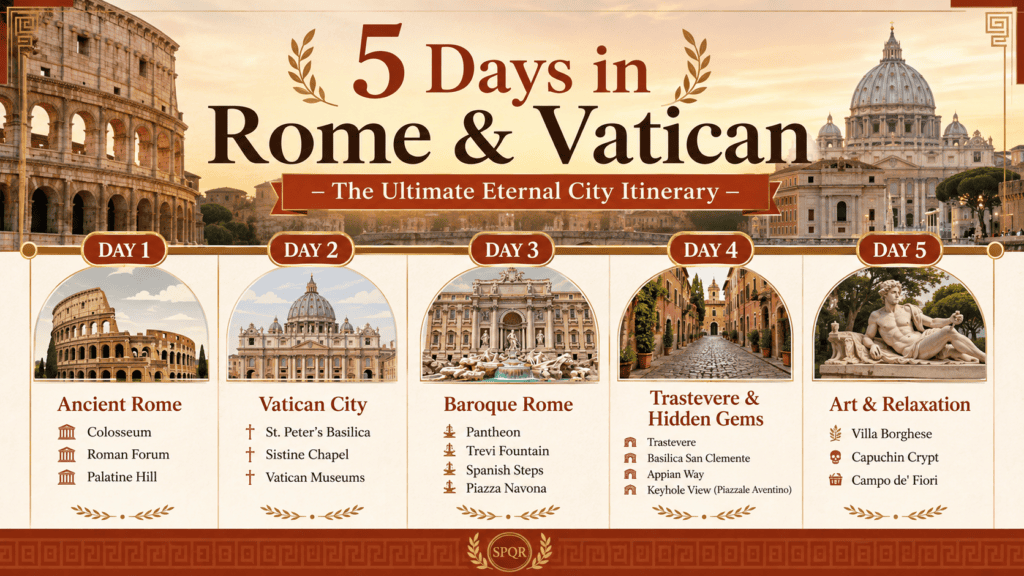
What Could a Practical 5-Day Rome and Vatican Itinerary Look Like?
| Day | Morning | Afternoon | Evening |
|---|---|---|---|
| Day 1 | Colosseum | Roman Forum and Palatine Hill | Monti or nearby historic center |
| Day 2 | Vatican Museums | Sistine Chapel and St. Peter’s area | Prati or Trastevere |
| Day 3 | Pantheon and Piazza Navona | Trevi Fountain and Spanish Steps | Historic center |
| Day 4 | Trastevere | Testaccio or Appian Way | Local dining |
| Day 5 | Villa Borghese | Borghese area or additional museum | Flexible final evening |
This itinerary is intentionally flexible. Move activities between days according to ticket availability, museum schedules, weather, and your preferred pace.
Planning more than Rome? Our 14-Day Global Itinerary provides another framework for combining major international destinations within a limited trip length.
What If You Only Have Two or Three Days?
If you have only two or three days, prioritize the Colosseum and archaeological area, Vatican City, and the historic center. Avoid trying to visit every museum and neighborhood in a single trip.
What If You Have a Week or More?
With a week or more, add additional museums, archaeological sites, parks, neighborhoods, food experiences, and possible day trips outside Rome.
Considering a longer European route? See our 10-country Europe backpacking route for an example of how Rome can fit into a broader multi-country journey.
What Should You Pack for Rome?
- Comfortable walking shoes
- Lightweight clothing suitable for the season
- A layer for cooler evenings
- Sun protection during warmer months
- Compact rain protection
- Reusable water bottle
- Portable charger
- Offline maps and accommodation details
- Clothing suitable for visiting religious sites
There is no universal daily walking distance for Rome. Your total mileage depends on accommodation location, transport use, attraction choices, and pace.
What Common Mistakes Should You Avoid in Rome?
Trying to See Everything
Rome contains more historical and cultural attractions than most visitors can reasonably cover in a few days. Choose several priorities for each day and leave room for meals and rest.
Ignoring Opening Hours
Check the current schedule for each attraction, particularly around public holidays, religious events, Mondays, and seasonal changes.
Assuming Every Ticket Works the Same Way
Timed entry, guided tours, combined tickets, security procedures, and reservation requirements differ by attraction.
Underestimating Walking Conditions
Historic streets can include cobblestones, uneven pavement, stairs, and crowded pedestrian areas. Plan footwear and daily distances accordingly.
Following Outdated Information
Prices, entry policies, restaurant hours, transport arrangements, and visitor rules can change. Recheck important details shortly before the trip.
How Can You Travel Respectfully in Rome and Vatican City?
- Follow instructions at archaeological sites and museums.
- Do not climb on or touch protected monuments.
- Dress appropriately when visiting religious sites.
- Keep noise low inside churches and religious spaces.
- Follow photography restrictions.
- Do not block entrances, stairways, or narrow pedestrian routes.
- Respect religious ceremonies and visitors attending them.
- Dispose of rubbish responsibly and help protect historic areas.
What Should You Check Before Leaving for Rome?
- Choose your travel dates and preferred pace.
- Book accommodation in a convenient area.
- Check official attraction opening hours.
- Reserve high-demand attractions where appropriate.
- Plan transportation between distant neighborhoods.
- Download offline maps.
- Prepare comfortable walking shoes.
- Check current weather forecasts.
- Review religious-site dress requirements.
- Keep backup payment and important travel documents available.
Conclusion
Rome rewards travelers who give themselves enough time to explore beyond the most famous monuments. The Colosseum and Roman Forum reveal layers of ancient history, while Vatican City offers extraordinary religious and artistic landmarks. Neighborhoods such as Trastevere, Monti, and Testaccio add another dimension through food, architecture, and everyday city life.
A practical Rome itinerary should balance major attractions with realistic walking distances, meal breaks, flexible time, and current ticket information. Planning this way makes it easier to enjoy the city without turning every day into a race between landmarks.
Whether your priority is ancient history, Renaissance art, architecture, food, or simply exploring Rome’s streets, the city offers enough variety to build an itinerary around your own interests.
Buon viaggio and enjoy your time in Rome. 🇮🇹