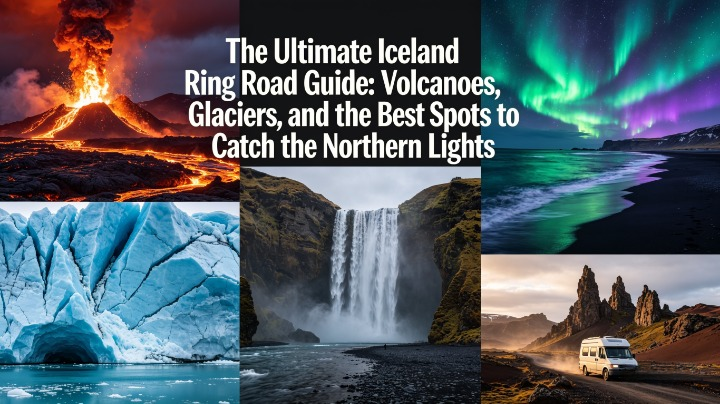
Travel conditions in Iceland can change quickly. Road conditions, weather, attraction access, tour schedules, opening hours, accommodation rates, and vehicle availability vary by season and location. Always check current information with official Icelandic sources, road authorities, and individual operators before travelling.
Iceland Ring Road at a Glance
Iceland’s Ring Road, also known as Route 1, is the country’s main road connecting many of its major regions. A road trip around the island can combine waterfalls, volcanic landscapes, glaciers, black sand beaches, geothermal areas, fishing villages, and dramatic coastal scenery.
The Ring Road is not simply a sightseeing route. Weather, daylight, road conditions, and seasonal access can significantly affect how much of the island you can comfortably explore. A good itinerary therefore leaves room for changing conditions instead of trying to fit every attraction into a fixed schedule.
| Planning Detail | Practical Guidance |
|---|---|
| Main route | Route 1 / Ring Road |
| Suggested duration | About 7–14 days for a road-trip framework; longer trips allow more flexibility |
| Starting point | Reykjavík or Keflavík area |
| Summer focus | Long daylight, hiking, waterfalls, road-trip flexibility, and outdoor activities |
| Autumn & winter focus | Dark skies, Northern Lights opportunities, winter scenery, and selected seasonal tours |
| Currency | Icelandic króna (ISK) |
| Driving priority | Check road and weather conditions before every longer drive |
When Is the Best Time to Drive Iceland’s Ring Road?
There is no single best season for every traveller. Summer offers long daylight and generally easier access to many outdoor areas, while the darker months create opportunities for Northern Lights viewing. Your choice should depend on the type of trip you want and your comfort with changing weather and driving conditions.
Autumn: September to October
- Longer nights create opportunities for Northern Lights viewing.
- Daylight decreases quickly compared with summer.
- Weather can change rapidly, so daily route planning should remain flexible.
- Some highland and seasonal routes may become inaccessible.
Winter: November to March
- Long dark periods provide good conditions for Northern Lights hunting.
- Snow, ice, wind, and storms can affect driving plans.
- Daylight hours are limited, so daily distances should be conservative.
- Some attractions, roads, and outdoor activities have seasonal restrictions.
Spring: April to May
- Daylight increases as the season progresses.
- Weather can remain changeable, particularly outside Reykjavík.
- Some winter conditions may remain in higher or remote areas.
- It can be a useful shoulder-season option for travellers who want fewer peak-season crowds.
Important: Northern Lights viewing is never guaranteed. Reykjavík’s tourism information generally describes the aurora season as beginning around late August or early September and continuing into April, but darkness, cloud cover, and solar activity all influence visibility.
How Should You Prepare for Driving in Iceland?
Driving is one of the most flexible ways to explore Iceland, but it also requires more preparation than a typical road trip. Weather and road conditions can change rapidly, particularly outside the capital region.
- Check official road and weather information before setting out.
- Never assume that yesterday’s road conditions will remain the same today.
- Adjust speed to visibility, surface conditions, wind, and traffic.
- Use only roads and marked routes that are legally open to your vehicle.
- Do not drive off-road. Iceland’s vegetation and volcanic landscapes are environmentally sensitive.
- Follow your rental company’s rules regarding vehicle type and road access.
For current road information, travellers should check Iceland’s official road authority before driving long distances. Emergency assistance in Iceland can be reached through 112.
Which Vehicle Is Right for Your Ring Road Trip?
The right vehicle depends on your route and travel season. A standard car can be suitable for a straightforward Ring Road itinerary when conditions are favourable, while a different vehicle may be required for specific roads or activities. A larger or four-wheel-drive vehicle does not automatically make difficult roads safe.
| Vehicle | Best Suited For | Planning Consideration |
|---|---|---|
| Standard car | Ring Road and accessible paved routes | Check seasonal road conditions |
| 4WD / AWD | Travellers with specific routes requiring additional traction | Confirm the vehicle is legally permitted on your planned roads |
| Campervan | Flexible accommodation and self-catering trips | Check campsite availability and seasonal operating conditions |
| Specialist 4WD | Approved highland routes and specialist excursions | Requires careful route and seasonal planning |
What Should You Pack for an Iceland Road Trip?
- Waterproof and wind-resistant outer layers.
- Warm insulating layers that can be added or removed.
- Waterproof walking shoes or hiking boots.
- Gloves, hat, and warm socks.
- Portable power bank and charging cables.
- Headlamp for dark-season travel.
- Reusable water bottle and travel snacks.
- Small first-aid kit and personal medication.
- Sunglasses and sunscreen.
- Camera equipment suitable for wet and windy conditions.
What Volcanic and Geothermal Experiences Can You Expect?
Iceland’s location on an active tectonic boundary has shaped many of the landscapes visitors see today. Geothermal areas, lava fields, volcanic craters, hot springs, and mountains can all appear along different parts of a road trip.
Reykjanes Peninsula
The Reykjanes Peninsula is known for volcanic landscapes and geothermal activity. Conditions around active volcanic areas can change, and access may be restricted when authorities determine that an area is unsafe.
- Follow barriers and official access instructions.
- Never approach fresh lava or restricted volcanic areas simply for photographs.
- Check current safety notices before visiting.
- Be aware that volcanic gas and unstable ground can present hazards.
Geysir and Geothermal Areas
- Geysir geothermal area: A major stop on the Golden Circle.
- Hverir: Known for geothermal vents, mud pools, and colourful ground.
- Reykjadalur: A hiking area associated with geothermal bathing.
- Geothermal lagoons: Popular for relaxing, but advance booking and operating conditions vary by facility.
How Should You Plan Glacier and Ice Cave Experiences?
Glaciers are among Iceland’s most distinctive landscapes, but they should be treated as serious natural environments rather than ordinary hiking terrain. Crevasses, unstable ice, changing weather, and water movement can create hazards that are difficult for inexperienced visitors to assess.
For glacier walks and natural ice-cave experiences, use an established operator and an experienced guide. Appropriate safety equipment and current local guidance are important for glacier activities.
Vatnajökull and Skaftafell
- Skaftafell: A major hiking area within Vatnajökull National Park.
- Jökulsárlón: A glacial lagoon known for floating ice.
- Diamond Beach: Coastal scenery near the lagoon where ice can appear along the black-sand shore.
Ice Cave Planning
Natural ice caves are seasonal and their safety can change with weather and ice conditions. Never enter an ice cave independently simply because it appears accessible. Tour operators and local authorities may close areas when conditions become unsafe.
How Can You Improve Your Chances of Seeing the Northern Lights?
The Northern Lights are created when charged particles from the Sun interact with gases in Earth’s upper atmosphere. Seeing them requires more than a strong forecast: darkness, cloud cover, location, and solar activity all matter.
- Darkness: Choose evenings with sufficiently dark skies.
- Cloud cover: Clear skies are essential for seeing the aurora.
- Solar activity: Higher activity can improve the possibility of visible displays.
- Low light pollution: Darker locations make weaker auroras easier to see.
- Patience: Conditions can change during the evening.
| Area | Why Consider It | Planning Note |
|---|---|---|
| South Coast | Dark landscapes and dramatic coastal scenery | Check wind and road conditions |
| Jökulsárlón area | Glacial scenery combined with dark surroundings | Stay clear of unsafe shoreline areas |
| North Iceland | Lower population density in many areas | Winter driving requires extra caution |
| Thingvellir area | Accessible from Reykjavík and surrounded by open landscapes | Check park access and weather |
| Reykjavík outskirts | Convenient option when staying in the capital | Move away from strong city lighting when practical |
For forecasts, use current information from Icelandic weather and aurora services rather than relying on a fixed prediction made months in advance.
What Can a 10-Day Iceland Ring Road Trip Look Like?
A 10-day itinerary can work as a practical framework for a Ring Road journey, but it should remain flexible. In winter or during periods of difficult weather, reducing daily driving distances may be more important than following the schedule exactly.
Looking for another road-trip framework? Our Route 66 Road Trip Masterclass explores a different long-distance driving itinerary, useful for comparing how route length, daily driving, and flexibility can shape a road trip.
Days 1–2: Reykjavík, Reykjanes and the Golden Circle
- Explore Reykjavík before beginning the longer road journey.
- Visit selected sights on the Golden Circle such as Þingvellir, Geysir, and Gullfoss.
- Add a geothermal bathing experience if it fits your schedule.
Days 3–4: South Coast
- Visit Seljalandsfoss and Skógafoss.
- Continue toward Vík and the surrounding coastal landscapes.
- Visit Reynisfjara only when conditions are appropriate and follow local safety warnings around waves and the shoreline.
Days 5–6: Vatnajökull and Southeast Iceland
- Explore Skaftafell and selected hiking routes.
- Visit Jökulsárlón and nearby coastal viewpoints.
- Consider a guided glacier or ice-cave activity when seasonal conditions and operator availability allow.
Days 7–8: East Fjords and North Iceland
- Drive through selected East Fjords communities rather than trying to stop everywhere.
- Continue toward Lake Mývatn and nearby geothermal landscapes.
- Visit Goðafoss and continue toward Akureyri if road conditions permit.
Days 9–10: West Iceland and Reykjavík
- Explore selected sights around West Iceland or the Snæfellsnes Peninsula.
- Allow enough time for the final drive rather than scheduling attractions until the last possible hour.
- Return to Reykjavík or the airport area according to your departure schedule.
Planning note: Treat this route as a framework rather than a fixed schedule. Your final route should depend on the season, road conditions, weather, accommodation availability, and the amount of driving you are comfortable with.
Planning a trip around several major destinations? Our 14-Day Global Itinerary offers another framework for organizing a multi-destination trip within a limited travel window.
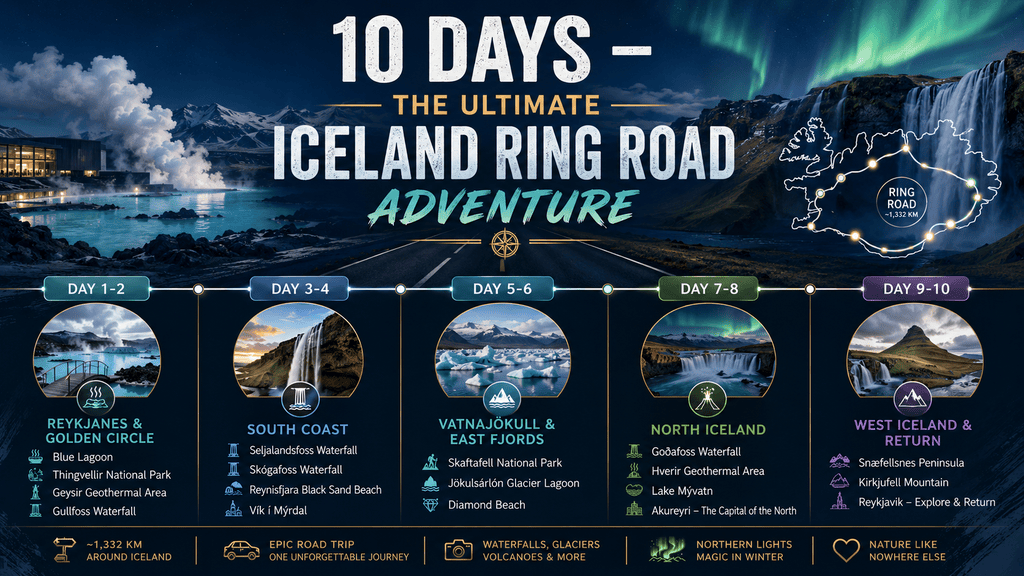
| Days | Region | Key Experiences |
|---|---|---|
| 1–2 | Reykjavík, Reykjanes & Golden Circle | Reykjavík, Þingvellir, Geysir, Gullfoss |
| 3–4 | South Coast | Waterfalls, Vík, Reynisfjara and coastal scenery |
| 5–6 | Vatnajökull & Southeast Iceland | Skaftafell, Jökulsárlón, Diamond Beach |
| 7–8 | East Fjords & North Iceland | Fjord landscapes, Lake Mývatn, Goðafoss, Akureyri |
| 9–10 | West Iceland & Reykjavík | Snæfellsnes or West Iceland, then return |
Which Waterfalls, Beaches, and Scenic Stops Can You Add?
Waterfalls
- Gullfoss: A major Golden Circle waterfall.
- Seljalandsfoss: Known for its distinctive cliff-side setting.
- Skógafoss: A powerful waterfall near the South Coast.
- Svartifoss: A waterfall framed by distinctive basalt formations in Skaftafell.
- Goðafoss: A scenic waterfall in North Iceland.
Black Sand Beaches
- Reynisfjara: Dramatic basalt formations and black sand near Vík.
- Diamond Beach: Coastal scenery near Jökulsárlón where pieces of glacial ice can wash ashore.
- Djúpalónssandur: A rugged black-pebble beach on the Snæfellsnes Peninsula.
Where Should You Stay on an Iceland Road Trip?
Iceland offers hotels, guesthouses, hostels, farm stays, cabins, and campsites. The best option depends on your route, season, vehicle, and desired level of flexibility.
- Hotels: Convenient for travellers who prefer predictable facilities.
- Guesthouses: Useful for smaller towns and regional stays.
- Cabins: Helpful for families or groups seeking more space.
- Camping: A flexible option during the appropriate season, but use designated campsites and follow current local rules.
- Campervan travel: Plan overnight stops around legal campsites rather than assuming roadside overnight parking is permitted.
Accommodation prices can vary substantially by season and location, so it is more useful to compare current rates for your exact dates than to rely on a fixed national average.
How Can You Control Your Iceland Road Trip Budget?
Iceland can be an expensive destination, but travellers can control costs by planning meals, accommodation, fuel, and activities together.
- Use supermarkets for breakfast and road-trip snacks.
- Choose casual local restaurants when eating out.
- Consider accommodation with kitchen facilities for longer stays.
- Limit unnecessary long detours that increase fuel and driving time.
- Compare activity prices and cancellation policies before booking.
Related travel safety planning: For broader guidance on protecting your personal data, wallet, and important documents while travelling internationally, see our Secure Travel Safety Handbook.
How Should You Handle Icelandic Weather and Road Safety?
Weather is one of the most important factors in an Iceland road trip. Strong wind, snow, ice, rain, fog, and rapidly changing visibility can affect travel plans.
- Check forecasts: Review current weather before every major driving leg.
- Check roads: Verify that your planned route is open and suitable for your vehicle.
- Allow flexibility: Keep spare time in your itinerary for delays.
- Respect closures: Never bypass a road barrier or safety restriction.
- Watch the wind: Strong gusts can make driving and opening vehicle doors hazardous.
- Be cautious near water: Waves and changing conditions can make coastal areas dangerous.
- Emergency: Call 112 for emergency assistance.
What Common Iceland Ring Road Mistakes Should You Avoid?
- Trying to see everything: A long attraction list can turn the trip into a driving marathon.
- Ignoring weather: A route that looks easy on a map may be difficult under poor conditions.
- Using fixed schedules: Give yourself alternatives when weather affects access.
- Driving off-road: Stay on legal roads and marked routes.
- Approaching dangerous coastlines: Respect warning signs and local safety instructions.
- Walking on glaciers independently: Use experienced guides and proper equipment for glacier activities.
- Assuming the Northern Lights are guaranteed: Even during aurora season, cloud cover and solar conditions can prevent sightings.
Final Iceland Ring Road Checklist
- ☐ Choose travel dates based on your preferred activities and daylight.
- ☐ Check current entry and driving requirements for your nationality.
- ☐ Reserve your rental vehicle and accommodation according to the season.
- ☐ Check road and weather conditions every day.
- ☐ Keep your itinerary flexible.
- ☐ Use official information for road closures and safety notices.
- ☐ Book specialist glacier or ice-cave activities with reputable operators.
- ☐ Pack waterproof and wind-resistant clothing.
- ☐ Protect Iceland’s fragile landscapes by staying on marked routes.
- ☐ Keep realistic driving distances and allow time for unexpected conditions.
Conclusion
An Iceland Ring Road trip can combine volcanic landscapes, waterfalls, glaciers, coastal scenery, geothermal areas, small communities, and opportunities to see the Northern Lights. The key is not trying to turn every day into a race between attractions.
Build your route around the season, check conditions regularly, and leave enough flexibility to change plans when weather or road conditions require it. With that approach, Iceland’s Ring Road becomes a practical road-trip experience rather than a checklist of places to rush through.
Plan carefully, drive responsibly, and give Iceland’s landscapes the time and respect they deserve.
Travel information such as road conditions, weather, attraction access, schedules, accommodation rates, and vehicle availability can change. Verify current information with official Icelandic sources and individual operators before travelling.