Travel information such as entry requirements, weather conditions, attraction access, tour schedules, and prices can change. Check current information with official Australian government, park, attraction, and tour-operator sources before travelling.
Australia Travel Guide: How to Plan Your First Trip
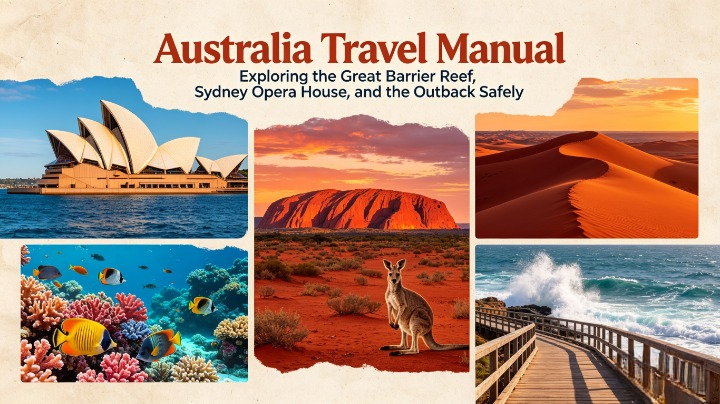
Australia combines major cities, tropical coastlines, ancient landscapes, national parks, and extensive remote areas. A first trip can include very different environments, from Sydney Harbour and the beaches of New South Wales to the Great Barrier Reef in Queensland and the desert landscapes around Uluru.
The country’s size makes planning especially important. Distances between destinations can be substantial, weather varies considerably by region, and outdoor activities may involve risks related to heat, water, wildlife, fire, or changing road conditions.
This guide focuses on practical planning for three major Australian experiences: Sydney and New South Wales, the Great Barrier Reef, and the Red Centre. It also introduces other regions, transportation considerations, accommodation, budgeting, and basic safety practices.
Which Part of Australia Should You Visit?
Australia is too large to treat as one compact destination. Instead of trying to cover the whole country, start by deciding what type of experience you want and how much time you have.
| If You Want… | Consider… | What You Can Expect |
|---|---|---|
| City, harbour, beaches, and culture | Sydney and New South Wales | Major landmarks, beaches, museums, neighbourhoods, and nearby natural areas |
| Reef and tropical marine experiences | Queensland and the Great Barrier Reef | Snorkeling, diving, boat tours, islands, and tropical environments |
| Desert landscapes and Indigenous cultural experiences | Uluru and the Red Centre | Uluru, Kata Tjuta, Kings Canyon, walking, and cultural experiences |
| Road trips and wilderness | Other Australian regions | Coastal roads, national parks, remote landscapes, and regional experiences |
The most practical choice is often to concentrate on one region or combine a small number of regions rather than trying to see Australia from coast to coast in a short trip.
Australia at a Glance
| Detail | Information |
|---|---|
| Capital | Canberra |
| States and territories | New South Wales, Victoria, Queensland, Western Australia, South Australia, Tasmania, Northern Territory, and the Australian Capital Territory |
| Currency | Australian Dollar (AUD) |
| Power | 230V, Type I plugs |
| Emergency number | 000 for police, fire, and ambulance |
| Mobile emergency number | 112 can be dialled from digital mobile phones where service is available |
| Travel planning | Allow extra time for long-distance travel and regional connections |
Important: Visa or travel-authorisation requirements depend on nationality and passport type. Do not assume that an ETA or eVisitor applies to every traveller. Check the current requirements through Australia’s official immigration information before booking.
What Should You Prepare Before Going?
Entry and Documentation
- Check the visa or travel-authorisation requirement for your passport before booking flights.
- Make sure your passport meets the entry conditions that apply to your nationality and visa.
- Keep copies of important travel documents and travel insurance information.
- Australia has strict biosecurity controls. Declare food, plant material, animal products, and other restricted items when required.
- For international arrivals, follow the instructions of Australian Border Force and biosecurity officers.
How Does Weather Affect Your Planning?
Australia’s seasons are opposite to those in the Northern Hemisphere, but there is no single “best season” for the entire country. Northern tropical areas, southern cities, Tasmania, and the Red Centre can have very different conditions at the same time.
| Region | General Conditions | Planning Consideration |
|---|---|---|
| Sydney and Southeast | Warm summers and cooler winters | Spring and autumn can be comfortable for sightseeing and outdoor activities |
| Queensland and Great Barrier Reef | Tropical conditions in the north | Seasonal rain, marine conditions, and local stinger advice can affect activities |
| Red Centre | Hot conditions are possible in summer with cooler nights in winter | Plan outdoor activities around local temperatures and park advice |
| Western Australia | Climate differs significantly between the north and south | Check regional forecasts rather than relying on national averages |
| Tasmania | Cooler and changeable | Mountain weather can change quickly |
What Safety Habits Matter Most?
- Protect yourself from the sun: Use sun protection, seek shade, wear suitable clothing, and stay hydrated.
- Take heat seriously: Reduce strenuous activity during extreme heat and follow local warnings.
- Respect wildlife: Observe animals from a safe distance and never feed or handle wild animals unless specifically instructed by an authorised professional.
- Follow fire restrictions: Bushfire conditions and fire restrictions vary by location. Check local authorities before lighting any fire.
- Prepare for remote travel: Tell someone your route when travelling into isolated areas and make sure your vehicle, fuel, water, communication, and navigation arrangements are suitable.
What Can You Do in Sydney and New South Wales?
Sydney is a practical starting point for many international visitors because it combines major landmarks, beaches, museums, neighbourhoods, and transport connections with access to surrounding natural areas.
Sydney Opera House
The Sydney Opera House is one of Australia’s best-known landmarks and a UNESCO World Heritage property. The building was designed by Danish architect Jørn Utzon and officially opened in 1973.
- Walk around the exterior and explore the harbour-side precinct.
- Consider an official guided tour if you want to learn more about the building’s architecture and history.
- Use public transport or ferries to combine the Opera House with other harbour attractions.
- Check event schedules in advance if you want to attend a performance.
Sydney Harbour Bridge
- Pedestrian routes provide views across Sydney Harbour.
- BridgeClimb offers a paid climbing experience subject to availability, conditions, and operator requirements.
- Ferries provide another way to see the harbour and connect several waterfront areas.
Blue Mountains
The Blue Mountains are a popular excursion from Sydney, with lookouts, walking tracks, waterfalls, eucalyptus forests, and the Three Sisters near Katoomba.
- Stay on marked tracks and observe signs around cliffs and restricted areas.
- Carry sufficient water for longer walks.
- Check weather, track conditions, and park alerts before setting out.
- Allow additional travel time if visiting independently.
What Other Sydney-Area Experiences Could You Add?
- Bondi to Coogee: A popular coastal walking route with beaches, viewpoints, and urban scenery.
- Taronga Zoo: A wildlife attraction with views toward Sydney Harbour.
- Royal Botanic Garden: A central green space close to the Opera House and harbour.
- Hunter Valley: A wine and food region that can be visited as a longer day trip or overnight excursion.
How Can You Experience the Great Barrier Reef?
Planning for outdoor safety? Our Secure Travel Safety Handbook covers broader practical precautions for protecting your personal information, wallet, and important travel documents while travelling internationally.
The Great Barrier Reef extends along Queensland’s coast and is made up of thousands of individual reefs and islands. It is a major destination for snorkeling, scuba diving, wildlife experiences, and boat tours.
Access depends on where you stay. Cairns, Port Douglas, and the Whitsunday region are among the commonly used bases, while other locations provide access to different sections of the reef system.
| Base | Common Experiences | Planning Note |
|---|---|---|
| Cairns | Reef day trips, snorkeling, diving | Large choice of tours and operators |
| Port Douglas | Outer reef and nearby rainforest experiences | Useful base for combining reef and Daintree-area activities |
| Airlie Beach | Whitsunday Islands, sailing, reef activities | Good option for travellers combining island and marine experiences |
What Should You Know About Water and Marine Safety?
- Follow instructions from lifeguards, guides, and boat crews.
- Use designated swimming areas where available.
- During periods when marine stingers may be present, follow local warnings and operator guidance about protective clothing.
- Do not touch coral or marine animals.
- Do not collect coral, shells, or other protected natural material.
- Check medical and fitness requirements before booking a scuba-diving activity.
How Can You Visit the Reef Responsibly?
- Choose reputable operators and check relevant environmental credentials where available.
- Follow instructions designed to prevent damage to coral and marine life.
- Avoid touching or standing on coral.
- Do not feed wildlife unless the activity is specifically authorised and supervised.
- Take rubbish back with you and use designated disposal facilities.
Which Reef Experience Could Suit You?
- Snorkeling: Suitable for visitors who want to explore shallow reef environments.
- Scuba diving: Available through introductory and certified-diver programs, depending on the operator.
- Glass-bottom boats: Useful for visitors who prefer to remain above the water.
- Scenic flights: Some operators offer aerial views of reef and island landscapes.
What Can You Experience Around Uluru and the Red Centre?
The Red Centre offers a very different experience from Australia’s coastal cities. Uluru-Kata Tjuta National Park is an important cultural and natural landscape, and visitors should plan activities around both environmental conditions and Anangu cultural protocols.
Uluru-Kata Tjuta National Park
- Uluru: A large sandstone formation with deep cultural significance for the Anangu people.
- Kata Tjuta: A group of large domed rock formations within the national park.
- Uluru walks: Visitors can explore designated walking routes around the base and surrounding areas.
- Sunrise and sunset: Different viewing areas provide opportunities to see changing light across the landscape.
Climbing Uluru is permanently closed. Visitors should respect the wishes of the Anangu traditional owners and follow all park rules and signs.
Kings Canyon and Watarrka National Park
Kings Canyon is another major Red Centre destination. Walking routes include sections with steep terrain and exposed areas, so visitors should check current conditions and park guidance before starting a walk.
- Start longer walks early when conditions are suitable.
- Carry enough water for the planned route.
- Wear appropriate footwear and sun protection.
- Check closures, heat warnings, and walking conditions before departure.
How Should You Prepare for Remote-Area Driving?
- Fuel: Plan fuel stops carefully because services can be widely separated outside major towns.
- Communication: Mobile coverage is limited or unavailable in some remote areas. Consider an appropriate emergency communication device for your route.
- Vehicle: Make sure the vehicle is suitable for the road conditions and that you understand the rental company’s restrictions.
- Flooding: Never attempt to cross a flooded road or watercourse when conditions are unsafe.
- Breakdown: If you break down in a remote area, assess the situation carefully and follow your rental provider or emergency service instructions.
How Should You Approach Australian Wildlife?
- Observe snakes, spiders, and other wildlife from a safe distance.
- Check shoes, clothing, and camping equipment before use in areas where wildlife may be present.
- In northern Australia, follow local crocodile safety signs and never swim in waterways where swimming is prohibited or unsafe.
- Do not approach or feed wild animals.
What Other Australian Regions Could You Add?
The regions below can expand an Australia trip, but they are best treated as additional options rather than destinations that need to be combined into a short first visit.
Western Australia: Remote Landscapes and Marine Experiences
- Purnululu National Park: Known for the distinctive sandstone formations of the Bungle Bungle Range.
- Rottnest Island: A popular island destination near Perth, known for beaches and quokkas.
- Ningaloo Coast: A marine destination with opportunities for snorkeling and seasonal wildlife experiences.
Victoria and Tasmania: Cooler Landscapes and Road Trips
- Great Ocean Road: A coastal road trip featuring cliffs, beaches, and the Twelve Apostles.
- Tasmania: Known for national parks, mountain landscapes, coastal scenery, and wilderness areas.
Tropical North: Rainforest and Northern Landscapes
- Daintree Rainforest: A tropical rainforest region north of Cairns with walking tracks and visitor areas.
- Darwin: A tropical city that can serve as a base for exploring parts of the Northern Territory.
- Kakadu National Park: Known for wetlands, landscapes, wildlife, and Aboriginal cultural heritage.
These regions can be the basis for a more specialised trip later. You do not need to add them simply because they appear on an Australia map.
Looking for a different kind of adventure? Our Queenstown Adventure Guide explores how a trip can be built around outdoor activities and adventure experiences rather than trying to cover a whole country.
How Much Time Do You Need for Australia?
The amount of time you have should influence how many regions you combine. Australia’s size means that transport between distant destinations can consume a significant part of a short trip.
| Trip Length | Planning Approach |
|---|---|
| Short trip | Concentrate on one major region rather than trying to cross the country. |
| About 10 days | A multi-region trip is possible, but distant regions will require careful domestic transport planning. |
| About 14 days | You have more flexibility to build a road-trip concept or combine several regions, depending on the route. |
| Longer trip | More regional variety becomes possible, but the itinerary should still account for distances and transport time. |
There is no requirement to see as much of Australia as possible. A focused trip can provide more time to experience each destination instead of spending too much of the journey moving between them.
What Could a 10-Day Australia Trip Look Like?
Need another multi-destination planning example? Our 14-Day Global Itinerary shows another way to structure a trip when several destinations must fit within a limited travel window.
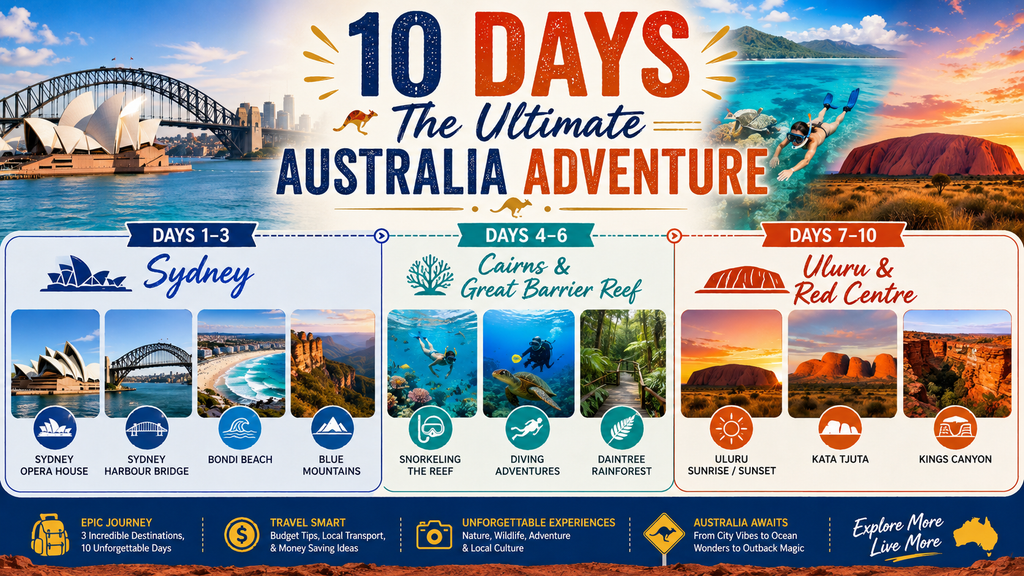
A 10-day highlights trip can connect Sydney, the Great Barrier Reef, and the Red Centre. This approach works best with domestic flights between regions.
- Days 1–3: Sydney, Sydney Harbour, beaches, and a Blue Mountains excursion.
- Days 4–6: Cairns or Port Douglas and a Great Barrier Reef experience.
- Days 7–10: Uluru and the Red Centre.
Trying to connect all three areas by road would require significantly more time. Treat this itinerary as a framework and adjust it according to flight schedules, activity availability, weather, and your own travel pace.
What About a 14-Day Road-Trip Concept?
A longer road trip could connect Sydney with destinations toward Victoria and South Australia before continuing toward the Red Centre. Exact routing should be adjusted according to road conditions, available time, vehicle type, and seasonal conditions.
Comparing long-distance road trips? Our Route 66 Road Trip Masterclass provides another example of planning a long road journey around route length, driving time, and flexibility.
How Should You Plan Your Australia Travel Budget?
Australia can be expensive compared with many Southeast Asian destinations. Actual costs vary substantially by city, season, accommodation type, transport choice, and how far in advance activities are booked.
| Category | Lower-Cost Approach | Mid-Range Approach | Higher-Cost Approach |
|---|---|---|---|
| Accommodation | Hostels, budget rooms, selected campgrounds | Hotels, motels, apartments | Premium hotels and resorts |
| Food | Supermarkets, food courts, casual meals | Cafés and casual restaurants | Fine dining and premium restaurants |
| Transport | Public transport and shared transfers | Rental car or domestic flights where practical | Private transfers and premium tours |
| Activities | Free walks, beaches, public attractions | Day tours and selected paid attractions | Private tours and specialist experiences |
Money-saving approach: Compare accommodation locations, use public transport in major cities, book popular tours early when practical, and avoid building an itinerary that requires unnecessary domestic flights or long-distance transfers.
What Common Planning Mistakes Should You Avoid?
- Underestimating distances: Australia is large, and moving between regions can consume an entire day.
- Planning around one national weather forecast: Conditions can be completely different between Sydney, Cairns, Uluru, and Tasmania.
- Ignoring local warnings: Check bushfire, flood, heat, marine, and park alerts before outdoor activities.
- Assuming mobile coverage everywhere: Remote areas may have limited or no mobile service.
- Overloading a short itinerary: Three major regions in ten days already require several transport connections.
- Ignoring biosecurity requirements: Declare restricted items when required and follow instructions on arrival.
10-Day Australia Itinerary: Sydney, Reef, and Uluru
| Days | Destination | Suggested Focus |
|---|---|---|
| 1–3 | Sydney | Sydney Opera House, Harbour Bridge, city areas, beaches, and a Blue Mountains day trip |
| 4–6 | Cairns / Great Barrier Reef | Reef tour, snorkeling or diving, and a rainforest excursion |
| 7–10 | Uluru / Red Centre | Uluru, Kata Tjuta, cultural experiences, and Kings Canyon where time and conditions allow |
Planning note: This itinerary is a framework rather than a fixed schedule. Check domestic flight times, attraction availability, park conditions, and tour schedules before assigning exact activities to each day.
Australia Travel Checklist
- ☐ Confirm the visa or travel-authorisation requirement for your passport.
- ☐ Check Australian biosecurity requirements before departure.
- ☐ Arrange suitable travel insurance.
- ☐ Check regional weather and safety alerts.
- ☐ Reserve popular reef, wildlife, or attraction experiences where necessary.
- ☐ Plan domestic flights carefully when combining distant regions.
- ☐ Carry suitable sun protection and hydration supplies.
- ☐ Download or save important booking and emergency information.
- ☐ Respect Indigenous cultural protocols and protected natural areas.
Final Thoughts
Australia is best approached as a collection of distinct regions rather than a single destination. Sydney offers urban culture and harbour landmarks, Queensland provides access to reef and tropical environments, and the Red Centre offers a very different landscape shaped by desert conditions and deep Indigenous cultural connections.
The most useful preparation is often simple: allow enough time for distances, check local conditions, follow safety instructions, and avoid treating dynamic travel information as fixed. With a realistic itinerary, travellers can experience Australia’s major highlights without trying to cover too much in a short trip.
Travel responsibly, respect the land and its people, and check current official information before you go. 🇦🇺
Note: Travel information such as prices, schedules, entry requirements, weather conditions, and attraction access can change. Verify current details with official Australian government, park, attraction, and tour-operator sources before travelling.