Price note: All prices in this guide are approximate planning ranges, not fixed prices. Hostel rates, transportation fares, attraction fees, food costs, exchange rates, and seasonal pricing can change. Check current prices directly with accommodation providers, transport operators, attraction websites, and official government sources before booking.
Introduction
Backpacking across Europe can be an exciting way to experience several countries in one trip without requiring a luxury-travel budget. The key is to choose a practical route, avoid unnecessary backtracking, compare transportation options, and understand where your money is likely to go.
This guide combines a 10-country European route with practical budgeting information, transportation ideas, accommodation considerations, food tips, and travel-safety guidance. For a more detailed execution guide covering routes, transport, and practical preparation across Europe, see our Europe Backpacking Manual.
The route covers:
United Kingdom → France → Belgium → Netherlands → Germany → Czech Republic → Austria → Hungary → Croatia → Italy
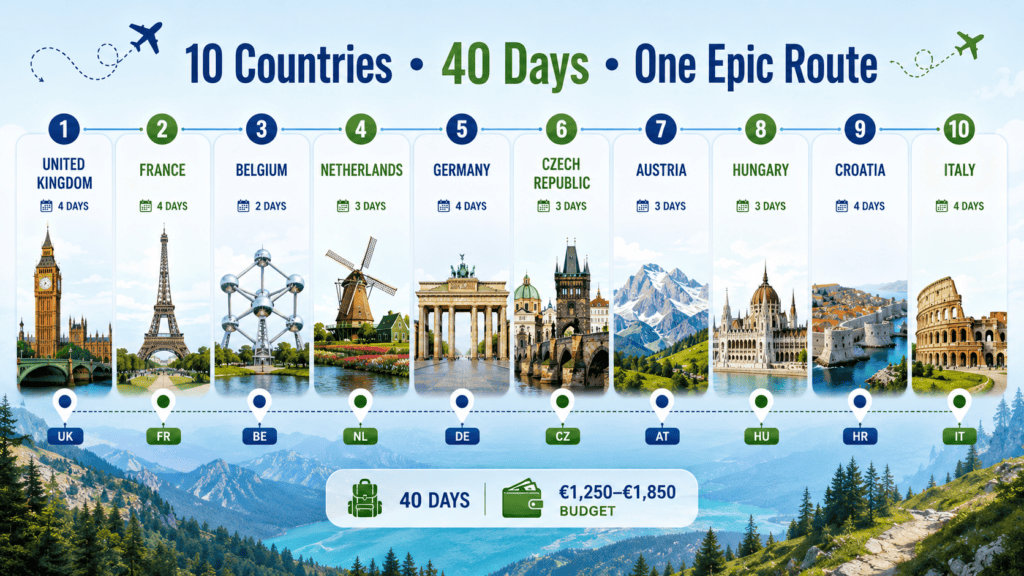
You do not need to visit every country in one trip. The route can be shortened or divided into several trips depending on your available time and budget.
A Practical 10-Country Europe Route
| Country | Suggested Stay | Example Destinations | Budget Focus |
|---|---|---|---|
| United Kingdom | 3–4 days | London | Accommodation and local transport |
| France | 4–5 days | Paris | Accommodation and attractions |
| Belgium | 2–3 days | Brussels, Bruges | Train travel and accommodation |
| Netherlands | 3–4 days | Amsterdam | Accommodation and attractions |
| Germany | 4–5 days | Berlin, Munich | Intercity transport |
| Czech Republic | 3–4 days | Prague | Food and accommodation |
| Austria | 3–4 days | Vienna, Salzburg | Accommodation and rail travel |
| Hungary | 3–4 days | Budapest | Accommodation and food |
| Croatia | 3–4 days | Zagreb, Split, Dubrovnik | Seasonal accommodation |
| Italy | 5–7 days | Venice, Florence, Rome | Accommodation and attractions |
The exact number of days depends on your interests. Travelers who prefer museums and historical attractions may want more time in major cities, while travelers focused on scenery and outdoor activities may prefer fewer cities and longer stays.
How Much Does Backpacking Europe Cost?
There is no single price for a European backpacking trip because costs vary considerably by country, season, accommodation type, transportation choices, and travel style.
As a broad planning range, a budget traveler may want to estimate approximately:
€40–€110 per person per day
This is a quick planning benchmark rather than a guaranteed daily price or a mathematical total of every expense category. Actual spending can vary considerably by country, season, accommodation type, transportation choices, and travel style.
A very careful traveler staying in inexpensive hostels and using low-cost transportation may spend less in some destinations. Major cities during peak travel periods can be considerably more expensive.
Example Daily Budget
The example below breaks daily spending into individual categories. Because it includes attractions and miscellaneous expenses separately, adding the ranges together produces a broader illustrative total than the quick planning benchmark above.
| Category | Approximate Daily Range |
|---|---|
| Hostel accommodation | €20–€50 |
| Food | €15–€30 |
| Local transportation | €5–€15 |
| Attractions | €0–€20+ |
| Miscellaneous | €5–€15 |
| Illustrative total | €45–€130+ |
The €45–€130+ figure is an illustrative bottom-up range based on the categories above, not a fixed daily price. Use the €40–€110 benchmark for an initial estimate, then use the detailed table to adjust your budget for your actual route, travel dates, and spending choices.
Example 40-Day Budget
For a longer trip covering multiple countries, it is better to create a range rather than rely on one fixed number.
A rough example for 40 days could look like this:
| Expense | Example Range |
|---|---|
| Accommodation | €800–€1,800 |
| Food | €600–€1,200 |
| Intercity transportation | €300–€800 |
| Local transportation | €150–€350 |
| Attractions and activities | €100–€400 |
| Miscellaneous | €100–€300 |
| Estimated total | €2,050–€4,850+ |
This example excludes international flights to and from Europe.
The final amount can change substantially depending on whether you travel during peak season, how frequently you move between cities, and how many paid attractions you visit.
A Shorter 14-Day Europe Route
You do not need 40 days to experience a multi-country European trip.
For travelers with only two weeks, a more practical route is:
Amsterdam → Berlin → Prague → Vienna → Budapest
This route reduces the amount of backtracking and gives travelers a combination of canals, historic districts, museums, architecture, food, and nightlife.
Days 1–2: Amsterdam, Netherlands
Use the first two days to explore Amsterdam’s canals, historic neighborhoods, public spaces, and major attractions.
A free walking tour can be a useful way to learn about the city, although tours advertised as free often operate through optional tips.
If you want to visit popular attractions such as the Anne Frank House, check the official attraction website well in advance because tickets and entry arrangements can change.
For budget travelers, compare hostel locations rather than choosing accommodation based only on the lowest nightly rate. Staying near convenient public transportation can reduce both travel time and local transportation costs.
Days 3–4: Berlin, Germany
Travel from Amsterdam to Berlin by train, bus, or another available service depending on your schedule and price comparison.
Berlin offers numerous historical and cultural attractions, including areas associated with the Berlin Wall, museums, public squares, and historic landmarks.
Budget travelers can save money by combining free outdoor attractions with a smaller number of paid museums or tours.
Days 5–7: Prague, Czech Republic
Prague is a good destination for travelers interested in historic architecture and walkable central neighborhoods.
Consider visiting:
- Charles Bridge
- Prague Castle
- Old Town
- Lesser Town
- Vltava River viewpoints
Walking is often one of the easiest ways to explore the historic center.
Food costs can vary significantly depending on where you eat. Restaurants immediately around major tourist attractions may be more expensive than places a few streets away.
Days 8–10: Vienna, Austria
Continue to Vienna by train or another suitable intercity service.
Vienna is particularly appealing for travelers interested in:
- Imperial history
- Architecture
- Museums
- Classical music
- Coffeehouse culture
- Public parks
A walking route through the central area can cover several major sights without requiring frequent transportation.
For museums and performances, compare individual tickets with city passes where available. A pass is not automatically cheaper; it depends on how many attractions you actually plan to visit.
Days 11–13: Budapest, Hungary
Budapest is the final major stop on this example route.
Possible highlights include:
- Buda Castle
- Hungarian Parliament views
- Danube riverfront
- Historic neighborhoods
- Thermal baths
- Ruin bars
Budapest can be relatively attractive for budget travelers, but prices vary by season and neighborhood.
If visiting thermal baths or nightlife venues, check current admission prices and opening hours before going.
Day 14: Departure
Keep the final day simple.
Allow enough time for:
- Breakfast
- Packing
- Check-out
- Transportation to the airport or station
- Unexpected delays
If your international flight departs early, staying closer to your departure airport or transportation connection the previous night may be worth the additional cost.
Transportation Across Europe
Transportation can become one of the largest expenses on a multi-country trip.
Before booking, compare:
- International and regional trains
- Long-distance buses
- Budget airlines
- Night trains
- Local public transportation
Trains
Rail travel can be convenient for routes connecting major European cities.
Travelers should compare the cost of individual tickets with available rail passes. A pass is not always the cheapest option.
Long-Distance Buses
Bus services can be useful for budget travelers, particularly when traveling between cities where bus fares are significantly lower than train fares.
The trade-off is usually longer travel time.
Budget Airlines
Budget airlines can offer low base fares, but the final price may increase after adding:
- Checked baggage
- Cabin baggage
- Seat selection
- Airport transfers
- Other optional services
Always compare the total journey cost, not just the advertised airfare.
Accommodation Tips for Backpackers
Hostels are often one of the most practical accommodation choices for budget travelers.
When comparing hostels, look beyond the nightly price.
Check:
- Location
- Public transportation access
- Recent reviews
- Locker availability
- Cancellation conditions
- Check-in and check-out times
- Kitchen facilities
- Laundry
- Security arrangements
A hostel that costs €5 more per night but eliminates expensive daily transportation can sometimes provide better overall value.
Eating Well on a Budget
Food costs can be controlled without avoiding local cuisine entirely.
Useful strategies include:
Choose local restaurants away from major tourist landmarks
Restaurants directly beside famous attractions often have higher prices.
Use supermarkets for breakfast and snacks
Simple items such as fruit, bread, yogurt, sandwiches, and drinks can reduce daily food expenses.
Try local street food
Many European destinations have inexpensive local specialties that provide a better cultural experience than relying entirely on international fast food.
Set a daily food allowance
Instead of trying to spend exactly the same amount every day, use a weekly food budget.
A more expensive dinner one evening can be balanced by a cheaper meal the next day.
Free and Low-Cost Things to Do
You do not need to pay for every attraction.
Depending on the destination, consider:
- Walking tours
- Public parks
- Historic neighborhoods
- City viewpoints
- Markets
- Riverfront walks
- Public squares
- Free museum days
- Outdoor landmarks
For paid attractions, check the official website for current admission rules, discounts, reservation requirements, and opening times.
Travel Safety Tips
Europe is generally accessible to tourists, but travelers should still take normal precautions.
Protect your belongings
Keep passports, payment cards, and important documents secure. For broader international travel-safety guidance, see our Secure Travel Safety Handbook.
Avoid carrying all your cash and cards in one place.
Be aware in crowded areas
Busy railway stations, public transportation, tourist attractions, and nightlife areas can attract pickpockets.
Keep bags closed and avoid leaving phones or wallets in easily accessible pockets.
Use official transportation information
When booking trains, buses, taxis, or airport transfers, verify operators and prices through official websites or established booking services.
Keep digital backups
Store secure copies of important documents such as:
- Passport
- Travel insurance
- Booking confirmations
- Emergency contacts
- Transportation reservations
Do not store sensitive information in an unsecured public location.
Visa and Entry Requirements
Visa and entry requirements depend on your nationality, destination, length of stay, purpose of travel, and current immigration rules.
Because requirements can change, travelers should not rely on an old travel article or a generic visa table.
Before departure, check:
- The official government or immigration website for your destination.
- The relevant embassy or consulate.
- Any applicable Schengen or border-entry requirements.
- Passport validity requirements.
- Travel insurance requirements, if applicable.
- Any additional authorization required for your nationality.
If your itinerary includes countries outside the Schengen Area, check those entry requirements separately.
Always verify the rules applicable to your own passport before booking a non-refundable trip.
Packing List for a Multi-Country Trip
A lighter backpack can make moving between cities considerably easier.
Consider packing:
Clothing
- Lightweight shirts
- Comfortable trousers
- Underwear and socks
- Lightweight jacket
- Weather-appropriate layers
- Comfortable walking shoes
Travel essentials
- Passport
- Payment cards
- Small amount of local currency where useful
- Phone and charger
- Universal travel adapter
- Power bank
- Travel documents
Health and personal items
- Basic personal medication
- Toiletries
- Small first-aid supplies
- Reusable water bottle
Check airline baggage restrictions before departure, especially if traveling with a budget airline.
How to Keep the Trip Affordable
The biggest savings usually come from planning the expensive parts of the trip carefully.
1. Avoid unnecessary backtracking
Choose a route where each destination naturally connects to the next.
2. Compare transportation
Check train, bus, and flight options before booking.
3. Travel outside peak periods when possible
Accommodation and transportation can become considerably more expensive during major holidays and peak summer periods.
4. Book important attractions early
Popular attractions may require advance reservations.
5. Stay longer in fewer places
Constantly changing cities can increase transportation costs and leave less time for actually experiencing each destination.
6. Track spending
Use a simple daily or weekly budget so you know whether you are staying within your target.
Sample 14-Day Budget
For the shorter Amsterdam-to-Budapest route, a rough planning budget might look like this:
| Category | Approximate Range |
|---|---|
| Hostels | €240–€340 |
| Intercity transportation | €140–€250 |
| Food | €170–€260 |
| Attractions | €50–€150 |
| Local transportation | €50–€100 |
| Miscellaneous | €50–€100 |
| Estimated total | €700–€1,200+ |
This is a planning range rather than a fixed package price.
The actual cost depends heavily on accommodation dates, booking timing, transportation choices, attraction selection, and personal spending habits.
International flights are not included.
Final Thoughts
Backpacking through Europe on a budget is less about finding the absolute cheapest option and more about making sensible choices.
A well-planned route can reduce unnecessary transportation costs. Hostels can keep accommodation affordable, while supermarkets, local restaurants, and free attractions can help control daily spending.
For a longer journey, the 10-country route provides a broad framework:
United Kingdom → France → Belgium → Netherlands → Germany → Czech Republic → Austria → Hungary → Croatia → Italy
For a shorter trip, the 14-day example offers a more manageable route:
Amsterdam → Berlin → Prague → Vienna → Budapest
Whichever route you choose, check current prices, transportation schedules, attraction requirements, and entry rules before departure.
The goal is not to visit as many countries as possible.
The goal is to build a route that fits your time, budget, and travel style while leaving enough room to actually enjoy the places you visit.