Travel information such as hotel rates, restaurant menus, admission fees, opening hours, transport services, and special-access experiences can change. Prices and availability mentioned in this guide should be treated as general references. Check the official venue, attraction, transport operator, or booking provider before making reservations.
London combines historic landmarks, royal heritage, established dining traditions, major museums, luxury hotels, and some of the world’s best-known shopping districts. For travelers who prefer a more comfortable and refined style of travel, the city offers many ways to build an itinerary around high-quality accommodation, memorable meals, cultural experiences, and convenient transport.
This guide focuses on practical luxury travel in London rather than claiming that every experience requires VIP access. It covers areas that are popular with upscale travelers, historic landmarks, premium dining, afternoon tea, private transport options, shopping, cultural experiences, safety considerations, and a sample five-day itinerary.
If London is part of a wider European journey, our Europe Backpacking Manual provides a broader route-planning perspective for combining multiple European destinations.
Choosing Where to Stay in London
Where you stay can make a significant difference to a luxury trip because London is large and attractions are spread across different neighborhoods. Areas such as Mayfair, Belgravia, Knightsbridge, Kensington, Chelsea, and St James’s are particularly useful for travelers looking for upscale hotels, restaurants, shopping, and central access.
Neighborhood Comparison
| Neighborhood | Character | Best For | Why Consider It |
|---|---|---|---|
| Mayfair | Elegant and central | Luxury hotels, galleries, shopping | Convenient for Bond Street, Green Park, and central attractions |
| Belgravia | Quiet and residential | Relaxed luxury and classic architecture | Close to Buckingham Palace, Sloane Square, and Hyde Park |
| Knightsbridge | Upscale and busy | Shopping and museums | Near Harrods, Hyde Park, V&A, and Royal Albert Hall |
| Kensington | Cultural and residential | Museums, parks, quieter stays | Useful for South Kensington museums and Hyde Park |
| Chelsea | Stylish and residential | Boutiques, restaurants, local atmosphere | Good option for travelers who prefer a neighborhood feel |
| St James’s | Historic and central | Royal connections, galleries, fine dining | Close to St James’s Park, Piccadilly, and Westminster |
| South Bank | Riverside and cultural | Views, museums, entertainment | Good access to the South Bank, Thames, and central London |
Rather than choosing an area solely because it has a reputation for being prestigious, consider the location of the attractions you plan to visit, the nearest Underground station, evening dining options, and the type of hotel experience you want.
What to Look for in a Luxury Hotel
- Convenient location near public transport or major attractions.
- 24-hour reception or concierge service when that matters for your itinerary.
- Secure luggage storage and in-room safe facilities.
- Clear cancellation and payment policies.
- Dining, spa, or wellness facilities if these are important to your stay.
- Accessible transport options for airport transfers and evening journeys.
Historic London: Landmarks and Special Experiences
London’s historic attractions range from royal palaces and medieval fortifications to major churches and government buildings. Some venues offer special tours, private guides, or experiences outside their standard admission products, but availability varies by date, venue, and event.
Landmarks Worth Including
| Landmark | Why Visit | Planning Consideration |
|---|---|---|
| Buckingham Palace | Royal residence and historic state rooms | Public opening periods and tour options vary by season |
| Westminster Abbey | Historic church associated with British royal ceremonies | Check opening hours and service-related closures |
| Tower of London | Historic fortress and home of the Crown Jewels | Allow several hours if you want to explore the complex properly |
| St Paul’s Cathedral | Christopher Wren’s famous cathedral and landmark dome | Check worship schedules and visitor access before visiting |
| Hampton Court Palace | Tudor history, palace interiors, and gardens | Located outside central London and better suited to a half-day visit |
| Kensington Palace | Royal history and changing exhibitions | Exhibitions and visitor access can change |
| Palace of Westminster | Historic parliamentary complex and Elizabeth Tower | Tour availability and security procedures should be checked in advance |
Special Access and Private Tours
Luxury travelers may find private guides, small-group tours, behind-the-scenes experiences, or special events offered by individual venues and tour operators. These should not be treated as permanent features of every attraction.
- Check the attraction’s official website for current premium or private tour options.
- Confirm exactly which areas are included before paying for a private experience.
- Check whether photography, security screening, or identification requirements apply.
- Do not assume that a private tour provides access to areas normally closed to visitors.
- For limited-capacity experiences, reserve through the official provider whenever possible.
Tower of London: A Practical Example
The Tower of London is particularly useful for travelers interested in combining history with a more specialized experience. Standard admission includes access to the historic complex and its principal visitor attractions, while separate experiences may be available at different times.
The Keys ceremony is a long-established ceremonial tradition associated with the Tower and is separately organized from ordinary daytime sightseeing. Availability, booking procedures, and visitor requirements should be confirmed directly with the official venue.
Westminster Abbey and St Paul’s Cathedral
Both sites are worthwhile for travelers interested in architecture and history. Westminster Abbey is strongly associated with British royal and national history, while St Paul’s Cathedral is known for its Baroque architecture and dome.
Because both are active religious sites, visitor access can be affected by services, ceremonies, or special events. Check the official schedule before planning a tightly timed itinerary.
Premium Dining in London
London’s luxury dining scene covers classic British restaurants, modern tasting menus, international cuisine, historic dining rooms, hotel restaurants, and traditional afternoon tea. Michelin recognition can be a useful reference, but it is not the only way to choose a memorable restaurant.
Dining Styles to Consider
| Experience | Good For | Planning Notes |
|---|---|---|
| Michelin-starred tasting menu | Special occasions and destination dining | Menus, service times, and dietary policies vary |
| Classic British restaurant | Traditional atmosphere and familiar dishes | Useful for combining food with London’s historic character |
| Luxury hotel restaurant | Convenience and polished service | Good option when staying at the same property |
| Afternoon tea | A classic London experience | Advance reservations are often recommended |
| Modern international dining | Contemporary menus and creative cuisine | Check current menus and dietary options before booking |
Well-Known Luxury Dining Areas
- Mayfair: A strong choice for high-end restaurants, hotel dining, and afternoon tea.
- Knightsbridge: Convenient for combining dining with Harrods, museums, and Hyde Park.
- Covent Garden: Useful for restaurants, theatres, and an evening in the West End.
- Belgravia: A quieter setting with upscale hotels and restaurants.
- Notting Hill: A good option for contemporary restaurants and a neighborhood atmosphere.
Afternoon Tea
Afternoon tea remains one of the easiest ways to add a traditional luxury experience to a London itinerary. Well-known hotels and department stores offer different interpretations, from formal dining rooms to more contemporary presentations.
- Check the current menu and price before booking.
- Ask about dietary requirements when making the reservation.
- Check dress guidance if you are visiting a formal hotel.
- Reserve ahead for weekends and popular holiday periods.
Restaurant Reservation Tips
- Book directly through the restaurant or its recognized reservation provider.
- Check cancellation and no-show policies.
- Confirm whether service charges are already included.
- Check the dress code when visiting formal dining rooms.
- Review the current menu if food allergies or dietary restrictions are important.
Luxury Transport Around London
Private transport can make certain parts of a luxury itinerary more convenient, particularly for airport transfers, evening events, shopping days, or journeys involving several destinations. For many daytime trips, London’s public transport network can still be the most practical option.
Transport Options
| Option | Best For | Planning Notes |
|---|---|---|
| Private chauffeur | Airport transfers, business trips, special occasions | Confirm vehicle type, waiting time, luggage policy, and cancellation terms |
| London Black Cab | Short city journeys and traditional London experience | Useful for central trips without advance planning |
| Ride-hailing | Flexible point-to-point travel | Check the app for current fare estimates and pickup instructions |
| London Underground | Fast movement around many central areas | Often practical during busy road periods |
| National Rail | Longer journeys and selected airport connections | Check the specific route and ticket conditions |
| River services | Scenic Thames journeys | Useful as both transport and sightseeing depending on the route |
When arranging a private driver, use a reputable licensed provider and confirm the pickup location, vehicle details, total cost, waiting time, and luggage arrangements in advance.
Luxury Shopping and Cultural Experiences
Shopping Districts
- Bond Street: International luxury fashion, jewelry, watches, and designer boutiques.
- Sloane Street: Designer fashion and luxury retail around Knightsbridge and Chelsea.
- Mayfair: Galleries, auction houses, bespoke services, and independent luxury stores.
- Jermyn Street: Traditional menswear, tailoring, shirts, and grooming.
- Harrods: A major department store experience combining luxury retail, food, and dining.
Cultural Experiences
- Visit major museums such as the British Museum, National Gallery, Victoria and Albert Museum, and Tate Modern.
- Check individual museums for guided tours, talks, exhibitions, and special events.
- Explore the Royal Academy of Arts when its exhibition program matches your interests.
- Consider a West End performance as part of an evening itinerary.
- Use official venue websites to check premium seating, private tours, or special access where available.
Safety, Payments, and Etiquette
Practical Safety
London is a major international city, so normal urban travel precautions are appropriate. Keep valuables secure, pay attention in crowded areas, and use reputable transport providers. A luxury hotel or neighborhood should not be treated as a guarantee of personal security.
- Keep passports and important documents secure.
- Use a hotel safe when appropriate for valuables.
- Be particularly attentive to bags and phones in crowded transport areas.
- Use official taxis, recognized ride-hailing services, or reputable private transfer companies.
- For emergencies in the UK, call 999 or 112.
Payments and VAT
Cards and contactless payments are widely used in London, although carrying a small amount of cash can still be useful for situations where card payment is unavailable.
Travelers should be careful with older online advice about VAT refunds. The VAT Retail Export Scheme for purchases taken home by overseas visitors from Great Britain was withdrawn from 1 January 2021. Visitors should therefore check the current UK government guidance and the retailer’s own arrangements before assuming that a purchase qualifies for a refund.
Dining and Hotel Etiquette
- Check the dress code before visiting formal restaurants or luxury hotels.
- Review the bill to see whether a service charge has already been added.
- Follow the venue’s reservation and cancellation policy.
- Queueing is an important part of everyday etiquette in London.
- Speak to hotel and restaurant staff respectfully, especially when requesting special arrangements.
A Practical 5-Day Luxury London Itinerary
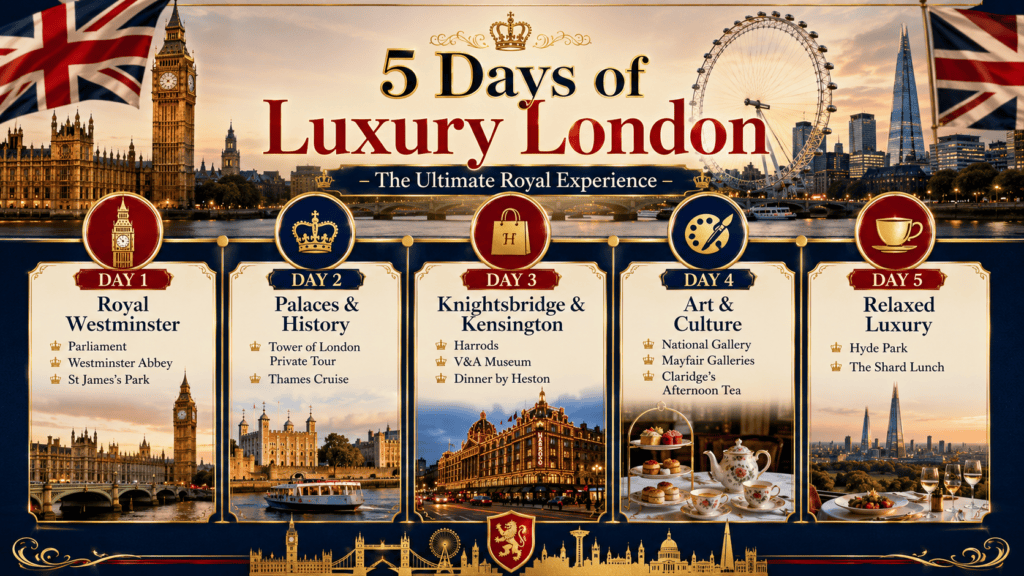
| Day | Focus | Suggested Experiences |
|---|---|---|
| 1 | Westminster | Westminster Abbey, Parliament area, St James’s Park, evening dining in Mayfair |
| 2 | Historic London | Tower of London, Thames walk or river journey, Covent Garden and dinner |
| 3 | Knightsbridge & Kensington | Harrods, Victoria and Albert Museum, Hyde Park, afternoon tea or dinner |
| 4 | Art & Mayfair | National Gallery, Mayfair galleries, Bond Street, afternoon tea |
| 5 | Flexible Luxury Day | Shopping, a museum or exhibition, spa time, and a West End performance |
How to Adjust the Itinerary
The itinerary should be treated as a framework rather than a fixed schedule. London attractions can become busy, weather can affect outdoor plans, and restaurant reservations may determine where you spend an evening.
If you want to turn this London stay into a broader multi-city vacation, our 14-Day Global Itinerary offers a wider framework for combining major cities in one trip.
- Move indoor museums to rainy periods.
- Group nearby attractions to reduce unnecessary travel.
- Reserve popular restaurants and special experiences before arrival.
- Leave flexible time for shopping or rest.
- Check attraction opening hours and event schedules on the day of your visit.
Final Planning Checklist
- Choose a hotel based on location as well as room quality.
- Confirm attraction opening hours before building a detailed schedule.
- Reserve restaurants and afternoon tea in advance when necessary.
- Verify private-tour availability directly with the venue or reputable operator.
- Arrange airport transfers with a licensed or reputable provider.
- Check current transport information before traveling.
- Review cancellation policies for hotels, restaurants, tours, and transport.
- Keep passports, payment cards, and important travel documents secure.
Conclusion
Luxury travel in London does not have to mean booking the most expensive option at every step. A better approach is to choose a convenient neighborhood, combine a few high-quality dining experiences with London’s historic and cultural attractions, and use private services selectively when they genuinely improve the trip.
With advance planning and current information from official venues and service providers, travelers can build a London itinerary that feels comfortable, polished, and personal while still leaving room to explore the city at a relaxed pace.