All prices mentioned in this guide are indicative planning ranges based on 2026 market conditions. Hotel rates, transportation fares, attraction fees, food costs, exchange rates, and other travel expenses can change by season, location, availability, and booking date. Always verify current prices and entry requirements directly with official providers or reputable booking platforms before making travel arrangements.
How Can You Plan a 40-Day Backpacking Trip Across Europe?
Planning a 10-country backpacking trip across Europe requires more than choosing destinations. Travelers need to balance transportation, accommodation, food, sightseeing, safety, documentation, and daily spending while allowing enough time to enjoy each destination.
This guide presents a practical planning framework for building a multi-country European itinerary without unnecessarily increasing costs or creating an overly rushed schedule. For a broader 10-country Europe route and budget framework, see our related guide.
The route below is an example rather than a fixed package. You can shorten it, extend individual stops, remove destinations, or change the transportation mix depending on your budget, interests, and available time.
Why Does a Clear Plan Matter on a Long European Backpacking Trip?
Europe offers an enormous range of destinations, but the cost of a backpacking trip can increase quickly when accommodation, transportation, meals, and attractions are booked without a clear plan. Major tourist areas can also be considerably more expensive than neighborhoods farther from the main landmarks.
A research-based approach can help travelers avoid many common planning mistakes. Comparing transport options, choosing accommodation with convenient public-transit access, allowing enough time between destinations, and checking local safety guidance can make a long European itinerary more manageable.
The most useful way to approach a multi-country trip is to make the route and budget work together. A cheaper destination does not automatically make a trip cheaper if reaching it requires an expensive transfer, while a slightly more expensive accommodation can sometimes reduce local transport costs when it is close to a useful station.
What Could a 10-Country European Route Look Like?
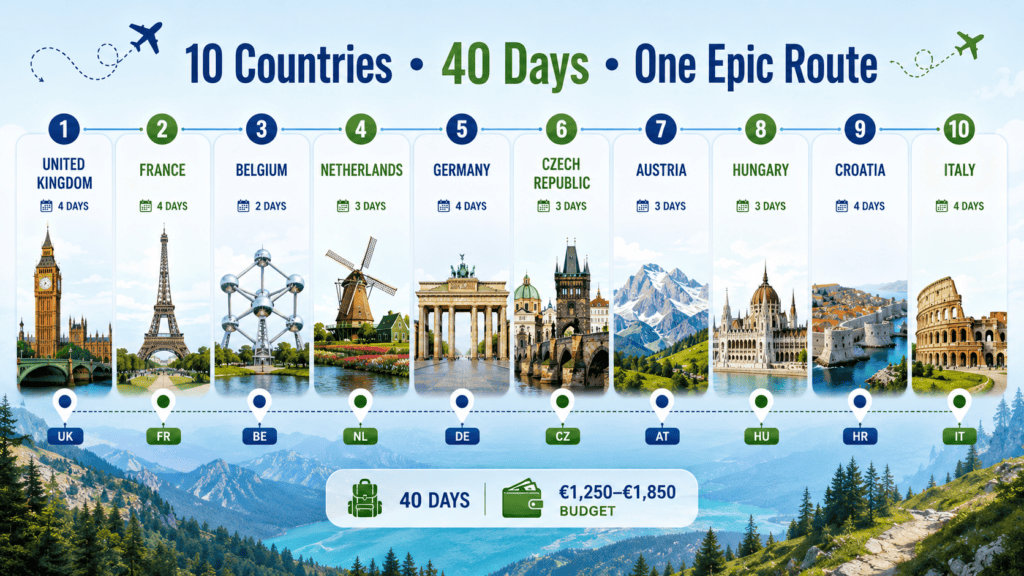
A circular route can reduce unnecessary backtracking and make it easier to connect neighboring destinations. The itinerary below is a planning example rather than a fixed schedule.
What Is the Suggested Route?
Start → United Kingdom → France → Belgium → Netherlands → Germany → Czech Republic → Austria → Hungary → Croatia → Italy → Return
The route should be treated as a framework. Depending on your priorities, you may spend more time in one country and less in another rather than trying to give every destination exactly the same amount of attention.
How Much Time Could Each Country Require?
| Country | Recommended Duration | Best Cities & Towns | Indicative Daily Cost (€) | Planning Focus |
|---|---|---|---|---|
| United Kingdom | 4–5 days | London, Edinburgh, York, Stonehenge | 45–60 | Compare transport fares, accommodation, museums, and sightseeing costs. |
| France | 4–5 days | Paris, Lyon, Nice, Annecy | 40–55 | Compare accommodation and dining costs between central Paris and other regions. |
| Belgium | 2–3 days | Brussels, Bruges, Ghent, Dinant | 35–45 | Compare accommodation and regional rail connections. |
| Netherlands | 3–4 days | Amsterdam, Utrecht, Rotterdam, Zaanse Schans | 38–50 | Compare central accommodation with options outside the most expensive areas. |
| Germany | 4–5 days | Berlin, Dresden, Munich, Neuschwanstein | 30–45 | Compare major-city accommodation with smaller destinations and regional connections. |
| Czech Republic | 3–4 days | Prague, Český Krumlov, Brno | 25–35 | Pay attention to exchange rates, reputable ATMs, and accommodation location. |
| Austria | 3–4 days | Vienna, Salzburg, Hallstatt, Innsbruck | 35–50 | Compare tourist-center accommodation with alternatives outside the busiest areas. |
| Hungary | 3–4 days | Budapest, Eger, Szentendre | 20–30 | Compare central tourist areas with local accommodation and dining options. |
| Croatia | 4–5 days | Zagreb, Split, Plitvice Lakes, Dubrovnik | 30–45 | Account for higher summer demand and accommodation availability. |
| Italy | 4–5 days | Rome, Florence, Venice, Cinque Terre | 35–55 | Compare prices by city and season, particularly in major tourist centers. |
Planning range: The source planning framework estimates approximately €1,700–€4,700 for 40 days for core trip expenses such as daily spending, inter-country transportation, insurance, applicable visa fees, and an emergency reserve, excluding international flights. Actual costs can fall outside this range depending on accommodation standards, travel dates, transportation choices, and activities.
How Should You Build Your Europe Backpacking Budget?
Travel costs vary heavily by season and destination. The ranges below are intended for planning rather than as guaranteed prices.
Travelers visiting during major holidays or peak summer periods should allow additional room in their budget, while flexible travelers may find lower rates during quieter periods.
What Could Your Daily Budget Look Like?
| Expense Category | Low Budget (€) | Mid Budget (€) | Money-Saving Approach |
|---|---|---|---|
| Accommodation | 10–18 | 18–30 | Consider well-reviewed hostel dorms, guesthouses, or simple private rooms. Compare location, reviews, cancellation terms, and included facilities. |
| Food & Groceries | 10–15 | 15–25 | Combine supermarkets, bakeries, markets, and occasional restaurant meals. |
| Local Transport | 3–8 | 7–15 | Walk where practical and compare single tickets with daily or multi-day passes. |
| Inter-Country Transport | 5–12 | 10–20 | Compare trains, buses, and flights using total cost, luggage, travel time, and station or airport location. |
| Activities & Entry Fees | 3–8 | 8–18 | Mix free attractions, parks, public spaces, and museums with selected paid experiences. |
| Miscellaneous | 2–5 | 5–10 | Allow for laundry, connectivity, small purchases, and unexpected expenses. |
| Total Per Day | €33–58 | €63–100 |
Which Expenses Need Their Own Budget?
Daily spending should not be the only number in your planning sheet. A long European trip also needs separate allocations for inter-country transport, travel insurance, applicable visa fees, and an emergency reserve.
| Item | Low Budget (€) | Mid Budget (€) | Planning Note |
|---|---|---|---|
| Daily expenses | 1,320–2,320 | 2,520–4,000 | Based on the daily planning ranges above. |
| Inter-country transport | 220–380 | 300–450 | Depends on route, booking time, transport type, and reservations. |
| Travel insurance | 30–70 | 50–100 | Policy prices and coverage vary by traveler, destination, duration, and insurer. |
| Visa fees | 0–150 | 0–150 | Requirements and fees depend on nationality and destination. |
| Emergency fund | 150–250 | 250–400 | Useful for unexpected delays, replacement items, transportation changes, or other unplanned costs. |
Important: These ranges should be treated as planning inputs rather than a guaranteed final trip price. Add the categories together using your own route, travel dates, and booking conditions before setting a final savings target.
How Can You Balance Spending Across Different Countries?
One practical approach is to spend more selectively in lower-cost destinations while keeping tighter limits in expensive cities. For example, travelers may choose a more comfortable meal or private room in a lower-cost destination while using hostels, supermarkets, and free attractions in higher-cost cities.
Which Transport Option Fits Each Part of the Route?
There is no single transportation method that is cheapest or fastest for every European connection. Compare the complete journey rather than looking only at the advertised ticket price.
| Option | Indicative One-Way Cost (€) | Speed | Best For | What to Check |
|---|---|---|---|---|
| Eurail / Interrail Pass | Varies by pass | Fast | Flexible multi-country rail travel | Reservations and supplements may apply on some services. |
| FlixBus / Long-Distance Bus | Often from €5+ | Slow–Medium | Budget-conscious travelers and short-to-medium routes | Travel times and luggage policies vary. |
| Budget Flights | Often from €10+ | Fast | Longer distances where rail is less practical | Baggage, seat, airport-transfer, and other fees can increase the final price. |
| Night Trains / Buses | Varies | Overnight | Long-distance travel and saving daytime travel hours | Availability, comfort, and reservation requirements vary. |
| BlaBlaCar Carpool | Varies | Medium | Routes where scheduled public transport is less convenient | Availability depends on drivers and departure times. |
| Regional Trains | Varies | Medium | Shorter journeys and scenic routes | May take longer than high-speed services. |
What Should You Check Before Booking Transport?
- Check ticket-validation rules — requirements vary by city and transport operator. Follow the instructions provided by the operator.
- Compare prices early — advance booking can sometimes provide lower fares, but not every route follows the same pricing pattern.
- Compare total journey cost — include luggage, airport transfers, station transfers, and other mandatory fees.
- Travel with manageable luggage — a compact backpack can make transfers between stations, buses, and accommodation easier.
- Compare connectivity options — eSIMs, local SIM cards, and roaming plans have different prices and coverage.
- Compare airport transfers — public transport, airport buses, rail services, and licensed taxi or ride-hailing options may differ significantly in price and convenience.
How Can You Choose Accommodation Without Overspending?
Accommodation can become one of the largest expenses on a long European trip. The cheapest room is not necessarily the cheapest overall choice if it creates expensive or inconvenient local transportation.
| Type | Indicative Price/Night (€) | General Considerations | Best For | Things to Watch For |
|---|---|---|---|---|
| Hostel Dorm (4–8 beds) | 10–25 | Often the lowest-cost option | Solo travelers, groups | Check recent reviews, lockers, room configuration, and reception arrangements. |
| Hostel Private Room | 25–50 | More privacy while retaining hostel facilities | Couples, travelers carrying valuables | Compare the private-room price with budget hotels or guesthouses. |
| Budget Guesthouse | 20–40 | Can provide a quieter stay | Longer stays, rest days | Check location, transport access, and cancellation conditions. |
| Camping | 5–18 | Potentially economical in suitable locations | Nature-focused trips | Availability, weather, local regulations, and campsite facilities vary. |
| Couchsurfing / Hosted Stay | Free or low cost | Can reduce accommodation expenses | Flexible travelers | Review host information carefully and prioritize personal safety. |
| Budget Apartment / Short-Term Rental | 30–60+ | Can work well for groups | Groups of 3+ | Check local regulations, cleaning fees, taxes, and final booking price. |
What Should You Check Before Booking?
- Check recent guest reviews and overall ratings on reputable booking platforms.
- Check reception or check-in arrangements, especially for late arrivals.
- Look for secure lockers or another suitable way to store valuables.
- Check the property’s distance from public transport and the surrounding area.
- Confirm Wi-Fi, breakfast, taxes, cleaning fees, and other included services before booking.
- Compare the final price rather than only the advertised nightly rate.
How Can You Eat Well Without Breaking the Budget?
| Item | Indicative Price (€) | Potentially Lower-Cost Destinations | Potentially Higher-Cost Destinations |
|---|---|---|---|
| Loaf of bread | 1.00–2.80 | Hungary, Czechia | UK, France |
| Street food meal | 3.00–8.00 | Hungary, Croatia | UK, Netherlands |
| Lunch set menu | 8.00–15.00 | Czechia, Hungary | France, Italy |
| 0.5L beer | 1.50–6.00 | Czechia, Hungary | UK, Ireland |
| Coffee | 1.50–4.00 | Italy, some Central European destinations | UK, Netherlands |
What Food Habits Can Help Protect Your Budget?
- Compare supermarkets and local markets — grocery prices vary by country and store.
- Consider lunch specials — in some destinations, lunch menus can offer better value than evening dining.
- Check local tap-water guidance — do not assume tap water is suitable everywhere; follow local public-health or municipal guidance.
- Compare restaurant locations — restaurants immediately beside major attractions can be more expensive, although location alone does not determine quality or price.
What Safety Risks Should Backpackers Prepare For?
| Risk | Where It May Occur | How It Can Happen | Basic Prevention |
|---|---|---|---|
| Pickpocketing | Crowded public transport and major tourist areas | Distraction techniques or theft in crowded areas | Keep valuables secured and bags closed. |
| Impersonation / Fake Officials | Tourist areas and transport hubs | Someone claims to be an official and requests money or documents | Ask for official identification and seek assistance from legitimate authorities when appropriate. |
| “Free” Items | Busy tourist areas | An item is offered and payment is later demanded | Politely decline unsolicited items and interactions. |
| Taxi Overcharging | Airports and train stations | Unclear fares, unauthorized services, or unnecessary detours | Use licensed services and confirm the fare or payment method before departure. |
| Card Skimming | Some ATMs or payment terminals | Criminals attempt to capture card information | Prefer reputable bank ATMs, inspect the machine, protect your PIN, and monitor transactions. |
What Basic Safety Habits Should You Keep Throughout the Trip?
- Know the local emergency number — 112 is the general European emergency number, but travelers should still check destination-specific guidance. For broader preparation, see our Secure Travel Safety Handbook.
- Keep digital and physical copies of important documents — store copies securely and make sure they can be accessed if the originals are lost.
- Separate payment methods — avoid keeping all cash and cards in one place.
- Share your itinerary — provide key travel plans and accommodation details to a trusted contact.
- Leave unsafe situations — if an area or interaction feels unsafe, move to a safer public location and seek appropriate assistance.
What Documents, Visas, and Insurance Should You Prepare?
Visa and entry requirements depend on nationality, destination, travel purpose, passport, and the rules in effect at the time of travel. The table below is a simplified planning overview rather than a substitute for official immigration guidance.
| Traveler Nationality / Status | Schengen Area | UK |
|---|---|---|
| EU / EEA / Switzerland | Generally no short-stay visa requirement within the relevant free-movement framework | Rules depend on nationality and current UK requirements |
| Visa-exempt non-EU travelers | Short stays may be visa-free under applicable 90/180-day rules | Entry requirements depend on nationality and current UK rules |
| Travelers who require visas | Schengen visa may be required | A Standard Visitor visa or another permission may be required depending on nationality and circumstances |
What Should You Check Before Booking Non-Refundable Travel?
- Check passport validity requirements for every destination before departure.
- Purchase travel insurance that matches the destinations, activities, duration, and coverage requirements of the trip.
- Check current proof-of-funds requirements for the relevant visa or border-entry rules.
- Check whether proof of onward or return travel may be requested.
- Verify all visa and entry requirements through the relevant official government or immigration source before booking non-refundable travel.
What Should You Pack for a Long European Backpacking Trip?
| Category | Suggested Items |
|---|---|
| Clothing | 3 short-sleeve shirts, 2 long-sleeve shirts, 1 fleece or warm layer, 1 waterproof jacket, 2 trousers, 1 pair of shorts, 7 pairs of socks/underwear, 1 scarf, comfortable walking shoes, and optional lightweight footwear |
| Tech & Documents | Universal adapter, power bank that complies with airline rules, unlocked smartphone, charging cables, and physical plus secure digital copies of important documents |
| Safety & Health | Padlocks, a secure money holder if useful, basic first-aid supplies, and any personally required medication |
| Extras | Reusable water bottle where appropriate, microfiber towel, earplugs, eye mask, and a small locker padlock |
The goal is not to pack for every possible situation. A manageable backpack makes frequent transfers easier and can also reduce baggage costs on some transportation options.
What Should You Know About the Different Countries on the Route?
The following points are intended as quick planning reminders rather than complete destination guides. Use them to identify where you may need additional research before booking.
| Country | Planning Reminder |
|---|---|
| United Kingdom | London transport costs can add up, so compare walking, buses, underground services, and available fare options. Many national museums offer free general admission. |
| France | Basic French greetings are useful when entering shops or interacting with local businesses. Compare restaurant prices beyond the busiest tourist areas. |
| Netherlands | Pay close attention to marked cycling lanes and traffic rules. Research local regulations before visiting cannabis-related establishments or areas. |
| Germany | Opening hours vary, and some stores have limited Sunday operations. Check payment methods and business hours before relying on a specific shop. |
| Czech Republic & Hungary | Use reputable banks or ATMs and check exchange rates carefully. Review menus and service charges before ordering. |
| Croatia & Italy | Summer demand can raise prices substantially. For popular attractions, trains, accommodation, and other limited-capacity services, advance planning can be useful. |
How Can You Keep a 40-Day Trip From Becoming Too Rushed?
A long route can look impressive on paper but become exhausting when every day is spent moving between destinations. The purpose of a 40-day framework is not to collect as many countries as possible; it is to create enough flexibility to enjoy the places you choose.
- Don’t overschedule — allow recovery time and flexibility instead of moving between cities every day.
- Consider shoulder-season travel — spring and autumn can offer a useful balance of weather, crowds, and prices, although conditions vary by destination.
- Learn basic local phrases — simple greetings, thank-you phrases, and useful travel questions can make everyday interactions easier.
- Track your spending — recording accommodation, transportation, food, and activity costs can reveal where the budget is increasing faster than expected.
- Stay flexible — transport delays, weather changes, sold-out attractions, and other disruptions can occur. Build alternatives into the itinerary where possible.
What If 10 Countries Are Too Much?
You do not need to complete all 10 countries simply because they appear in the example route. Removing one or more destinations can create additional time for the places that matter most to you and may also reduce transportation costs.
A shorter route can also make it easier to stay longer in each destination, reduce packing and unpacking, and leave more room for unexpected discoveries.
What Should You Check Before Leaving?
- Confirm passport validity and current entry requirements.
- Check visa requirements for every destination that applies to your nationality.
- Confirm travel insurance coverage.
- Review the main inter-country transportation bookings.
- Check baggage policies for flights and long-distance transport.
- Confirm accommodation addresses and check-in arrangements.
- Prepare secure copies of important documents.
- Check current exchange rates and payment options.
- Prepare a realistic emergency fund.
- Download important booking information and travel documents for offline access.
- Review local transport information for your first destination.
- Leave enough flexibility to handle delays, weather, or changes in plans.
Conclusion
Backpacking across 10 European countries can be an ambitious but manageable travel project when the route, budget, transportation, accommodation, safety considerations, and entry requirements are planned in advance.
A flexible circular itinerary can help reduce unnecessary backtracking, but the route should always serve the traveler rather than the other way around. If 10 countries make the trip too rushed, removing destinations can create more time for the places that matter most.
The most important step is to treat every price and travel requirement as a planning reference rather than a guarantee. Check current information with official transport providers, accommodation platforms, immigration authorities, insurers, and other relevant service providers before making final arrangements.
With realistic budgeting, sensible pacing, and careful preparation, travelers can build a European backpacking itinerary that balances exploration, comfort, safety, and affordability.